Climate change could cause trees to grow faster, accelerating the rate at which they absorb carbon from the atmosphere. But these trees may be likely to die sooner, a study finds.The research, conducted in high-altitude conifer forests in Spain and Russia, suggests that climate change could cause the trees to “live fast and die young”, the authors say – reducing the ability of these forests to act as a carbon sink over long timescales.The findings show that planting forests to soak up greenhouse gas emissions could have more limited potential than previously thought, the lead author tells Carbon Brief.The research is “impressive”, but may be too “bold” in its conclusions, another scientist tells Carbon Brief.
“The common belief is that in a warmer and a more CO2-enriched world, trees will uptake more carbon from the atmosphere. Based on this, people are starting political actions to plant trees. What we are adding to this debate, is to say: ‘This is correct but it’s only half of the story.’
“What is neglected is the ‘carbon residence time’ – how long the carbon taken up by terrestrial vegetation is actually captured. In our study, we show that faster growing trees and other types of vegetation will die younger. By doing that, they are going to release all of the carbon that they have sequestered.”
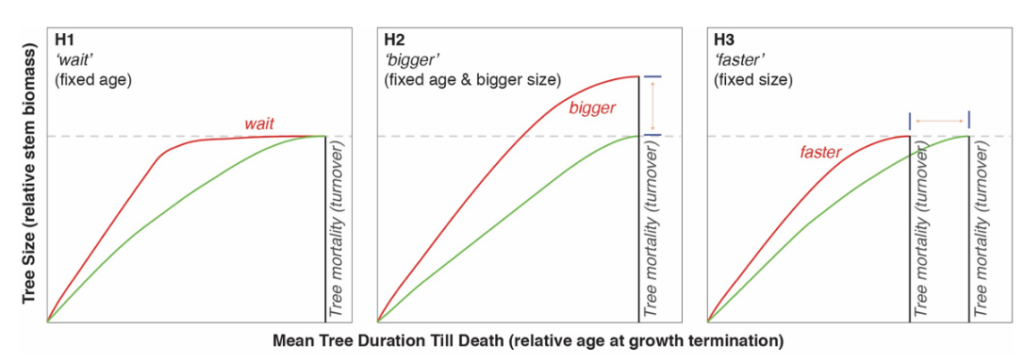
When humans release CO2 into the atmosphere, around one of it is absorbed by plants.Plants use CO2 during photosynthesis to create new materials, such as leaves, shoots and roots. Because of this, forests act as “carbon sinks” – storing vast amounts of carbon over long timescales.Climate change is likely to increase the rate at which trees . The study focuses on one reason for this, which is that warming temperatures may increase the overall length of the in temperate regions, explains , a researcher of environmental systems analysis from the and lead author of the study published in . He tells Carbon Brief:The authors studied tree-ring data taken from dead and living trees in mountainous forests in Europe – including more than 1,100 mountain pines in the Spanish Pyrenees and more than 600 Siberian larch trees in the Altai region of Russia.For each tree, the number of rings present were used to calculate age, while the thickness of the rings gave a picture of past growth rate. The authors chose tree samples spanning the pre- and post-industrial era.
“The analysis convincingly shows that there is a tendency for trees that grow faster when young to die earlier. By using both living and relict trees, the study avoids biases caused by survivorship which would affect studies just looking at living trees.
“However, to conclude that forests won’t store more carbon under future climate regimes from these results is bold. The results only show that trees that grow faster die younger – and don’t show whether growth rate is related to the maximum size trees can reach. Thus, it is perfectly possible that reality is somewhere between the ‘bigger’ hypothesis and the ‘faster’ hypothesis, with the trees that grow faster getting bigger but dying younger.”
Article information
Büntgen, U. et al. (2019) Limited capacity of tree growth to mitigate the greenhouse gas effect under predicted warming, Nature Communications, http://dx.doi.org/10.1038/s41467-019-10174-4
The findings show that planting forests to soak up greenhouse gas emissions could have more limited potential than previously thought, Büntgen says. “The capacity to mitigate climate change is reduced when trees are dying earlier and releasing their carbon.”It is still not certain if the “live fast, die young” effect would occur in other parts of the world, such as tropical forests, he says. However, a published in 2015 found that temperature rise over the past decade could have played a role in early tree death in the Amazon rainforest.The authors present an “impressive dataset”, says , a forests researcher from the , who was not involved in the study. He tells Carbon Brief: