More than half the world could see ‘record-setting heat’ every year by 2100
More than half of the world could see new temperature records set in every single year by the end of the century if global warming is not curbed, a study finds.And new heat records could be set in two-thirds of the world’s least developed countries each year by 2100 under the same scenario, the research adds.Limiting global warming to below 2C above pre-industrial levels could reduce the extent of land seeing record-setting heat by almost three quarters, the lead author tells Carbon Brief.The research “nicely illustrates the pace of change”, another scientist tells Carbon Brief. However, it is worth noting that there are limitations to using climate models to project future temperature extremes, he adds.§ Heating up
heat extremesfour yearshottestIn 2016, temperatures at the Mitribah weather station in Kuwait reached 53.9C – the highest ever seen in Asia, according to a recent study.
“We investigated the rate of extreme high-temperature record-setting and ‘record-smashing’ – when a record exceeds the record it replaces by a large amount. The research shows that the benefits of reducing global greenhouse emissions is clear by the end of the 21st century in terms of both reducing the pace of record-setting and record-smashing.”
climate modelsRCP8.5RCP2.6
“These benefits take more than 20 years to become clear – the likelihood of setting extreme temperature records is projected to remain at high levels for the next two decades.”
§ Smashing summers
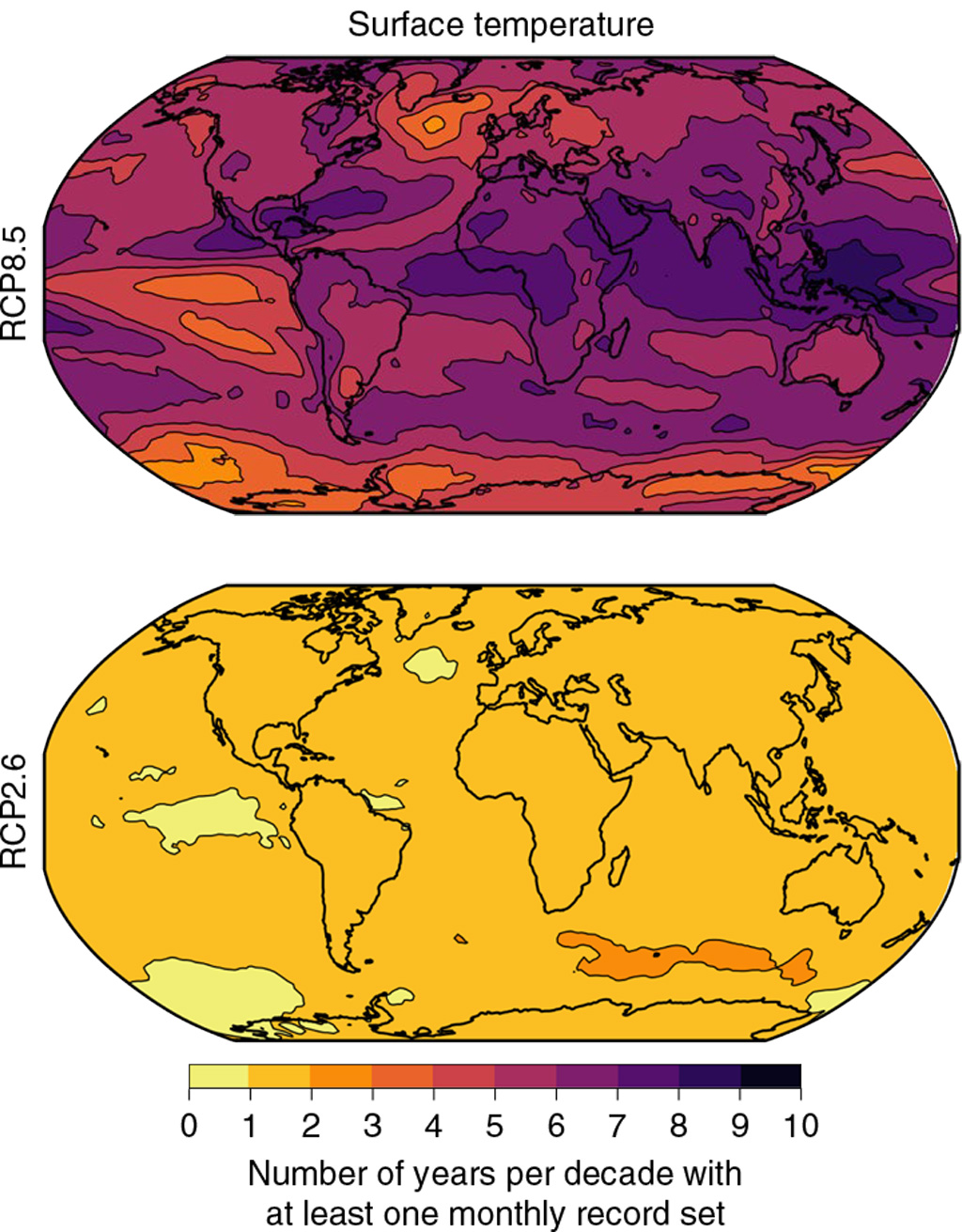
“The highest pace at which records will be set and the greatest benefits from reducing emissions on this pace tend to occur in the poorest countries. This [is because] developing countries tend to be in the tropics whereas developed countries tend to be in the middle and high latitudes.”
regional variations§ ‘Pace of change’
Prof Piers ForsterPriestley International Centre for ClimateUniversity of Leeds“Also, records in observations are very dependent on local meteorology, which these global climate models don’t capture without ‘downscaling’.
“However, this work is less about the regional or specific details of the records so I’m inclined to trust its broad findings. Looking at continued record setting is interesting and nicely illustrates the pace of change.”
Article information
Power, S. B. & Delage, F. P. D. (2019) Setting and smashing extreme temperature records over the coming century, Nature Climate Change, https://www.nature.com/articles/s41558-019-0498-5