Guest post: A new approach for understanding the remaining carbon budget
Dr Joeri Rogelj is a lecturer in climate change and the environment at the Grantham Institute at Imperial College London, and Prof Piers Forster is professor of climate physics at the University of Leeds and founding director of the Priestley International Centre for Climate. The concept of a “carbon budget” has proved to be both elegantly simple and stubbornly complicated.The theory dictates that the total amount of CO2 emitted until emissions are taken down to zero determines the maximum warming that the world will subsequently experience. This was the promise from a series of seminal studies published nearly a decade ago.Our latest understanding of climate science teaches us that this promise is still largely kept, but it turns out things are not quite so straightforward when estimating how much carbon budget remains if we want to cap warming to a precise level. The estimated size of the remaining carbon budget can depend on a whole range of factors, which makes it much trickier to compare different estimates directly.As authors on the Intergovernmental Panel on Climate Change’s special report on 1.5C of global warming (SR15), part of our task was to bring the different carbon budget estimates together.In our new study, published in Nature, we now show how the estimates from early carbon budget studies can be reconciled – and how carbon budget nuances can be understood to inform the climate action required by the Paris Agreement.§ Remaining emissions
fifth assessment reportIPCCcarbon budgetkeep warming well-below 2C and preferably 1.5Cnet-zero goalsnewupdatedmorenuancedestimatesremaining carbon budgetlimited understanding of the reasonsconfusion amongst science commentators§ Clearing up contributions
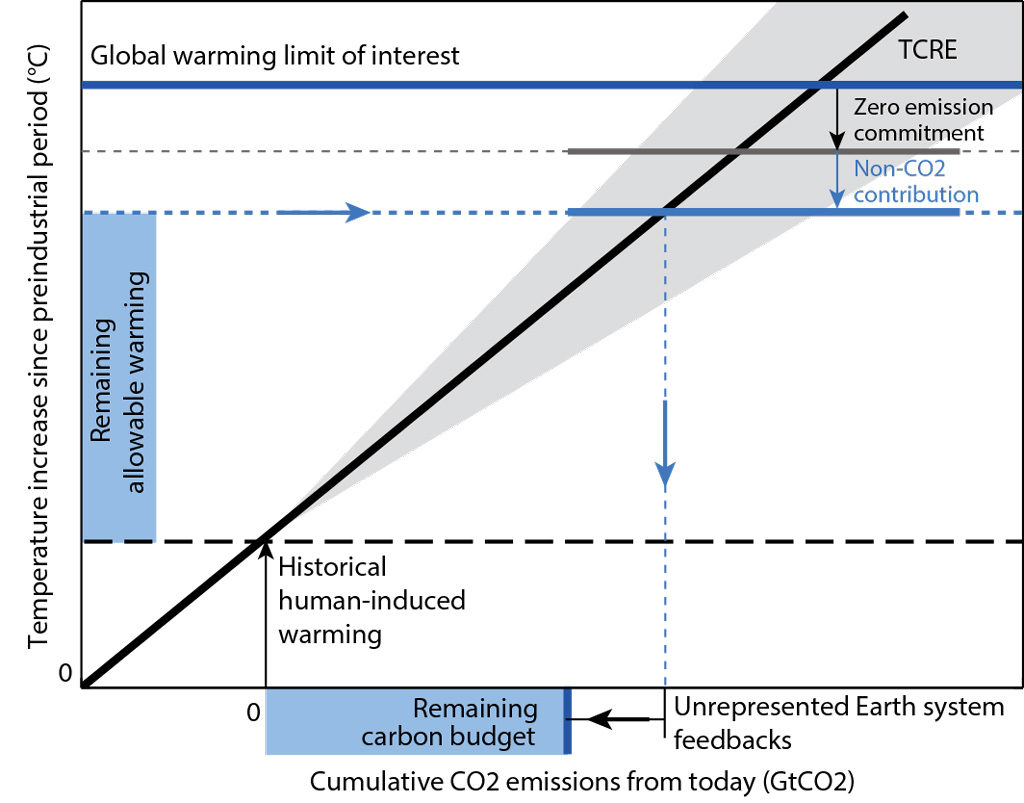
remaining carbon budgetreview rounds- The estimate of global warming up to the present day;
- The assumed future warming from emissions of non-CO2 forcings such as methane and black carbon and the reduction of cooling sulphate emissions;
- The amount of warming still in the pipeline once emissions are brought back to zero;
- The ratio between cumulative CO2 emissions and global warming (also known as the transient climate response to cumulative carbon emissions, or “TCRE”); and
- The extra emissions from Earth system processes or feedbacks that are typically not included in the models used to make these estimates, such as thawing permafrost.
§ Whence the confusion?
confusing variationsthat are already less preciseDifferent methods of calculating global temperaturesslightly different approachesclimate modelsarbitrary changessuch as permafrost thawingsmaller remaining carbon budgetscumulative CO2 emissions from scenariosmistaken for carbon budgetssupplementary information§ Communicating the future
Article information
Rogelj, J., Forster, P. M., Kriegler, E., Smith, C. J. and Séférian, R. (2019) A framework to estimate and track remaining carbon budgets for stringent climate targets, Nature, doi:10.1038/s41586-019-1368-z [the full paper is free to access at this link]