A reduction in air pollution brought about by shifting away from fossil fuels would not inadvertently cause a short-term acceleration of global warming, a new study says.Earlier modelling work using scenarios where fossil-fuel burning ends instantaneously had suggested that a rapid decline in aerosol emissions could remove their cooling impact on the climate and cause a spike in warming.However, the new study, published in Nature, finds that “even the most aggressive” shift from fossil fuels to clean alternatives to limit warming to 1.5C “provides benefits for climate change mitigation and air quality” at all timescales.The study makes the “clear and important point” that “aerosol cooling is no reason not to mitigate our emissions”, another scientist tells Carbon Brief, but “we need to be mindful of the potential regional climate implications of rapid removal of air pollution”.
“Their presence [directly] reflects more incoming sunlight back to space, cooling the atmosphere, but they also have effects on changing the reflectivity and lifetimes of clouds, which may have larger and more uncertain effects.”
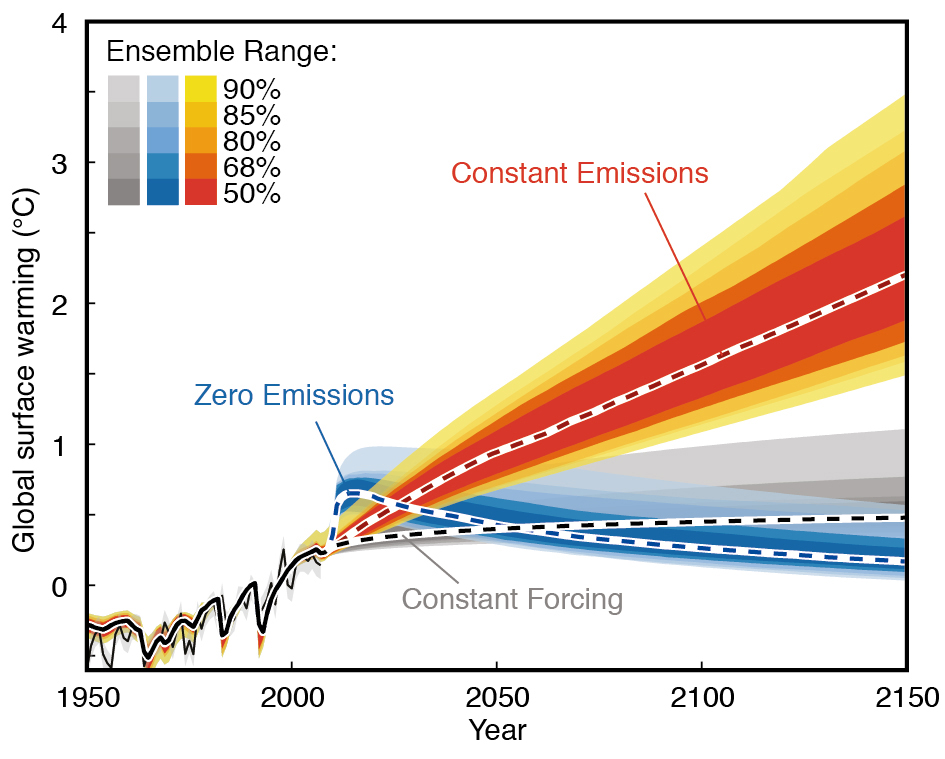
previous studies have identifiedParis AgreementIntergovernmental Panel on Climate Changefrequently asked question 12.3Image - Figure 1 from FAQ 12.3 of the IPCC AR5. Shows warming projections for constant atmospheric composition (constant forcing, grey), constant emissions (red) and zero future emissions (blue) starting in 2010, with estimates of uncertainty. The thin black line and shading denote the observed warming and uncertainty. Source: IPCC (pdf) (note)In addition to emitting greenhouse gases, such as CO2 and methane, burning fossil fuels also releases tiny particles known as aerosols. They typically linger in the atmosphere for .Sulphur dioxide, for example, is emitted from power stations and vehicle exhausts. It reacts in the atmosphere to form .Aerosols have a mixed influence on the climate, explains co-author , a research fellow at the . He tells Carbon Brief:The impact of these cloud changes depends on their type, says Smith: “Low clouds are generally cooling and high clouds generally warming, but evidence suggests that low clouds win out and cloud effects due to aerosols generally cool the climate.”Overall, “we believe that man-made aerosols have offset a significant amount of greenhouse-gas warming up until now”, says Smith, “perhaps in the region of 0.5 to 1C”.So if aerosols emissions are masking the full warming impact of greenhouse gases, the logical implication is that removing them will result in an uptick in warming. This is indeed what .But because greenhouse gases and aerosols are often emitted through the same processes – such as the burning of fossil fuels – this has led to the “fairly common perception” that phasing out unabated fossil-fuel use to meet ambitious climate targets – such as the – “leads to trade-offs, with a near-term increase in both the magnitude and the rate of warming”, the paper says. The study refers to this as a “climate penalty”.However, there is a key limitation with these studies, says Smith, in that they typically assume an instantaneous removal of all emissions. This is not “realistic in our complex, interdependent world”, he says, which would take much longer to phase out fossil fuels.In the fifth assessment report of the (IPCC), for example, “” (pdf) states that “eliminating short-lived negative forcings from sulphate aerosols at the same time (e.g. by air pollution reduction measures) would cause a temporary warming of a few tenths of a degree”.The accompanying figure (see below) showed this spike in global surface warming (blue dotted line) compared to constant emissions (red) and if the atmospheric concentration of greenhouse gases was held constant at present-day levels (grey).
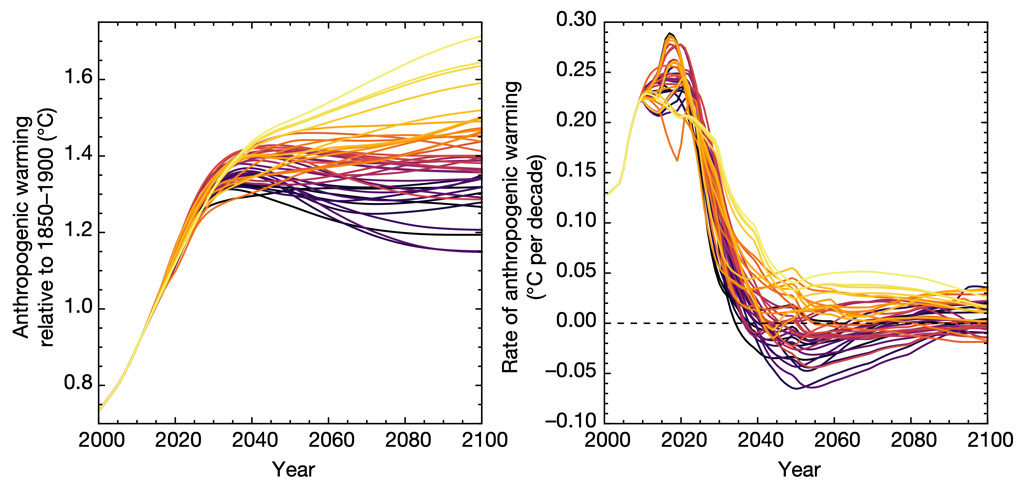
IPCC’s special report on 1.5C of warmingFinite Amplitude Impulse Responsecomplex climate modelsProf Drew ShindellDuke UniversityImage - Global average surface temperatures, relative to pre-industrial levels (left) and warming rates plotted over time (right) in the 1.5C pathways with little or no overshoot. Each line represents the ensemble mean result for a specific 1.5C pathway. Source: Shindell & Smith (2019) (note)The new study investigates “whether this climate penalty exists in realistic scenarios of the transition to clean energy”. It takes the emissions pathways used in the that keep warming below 1.5C, or with a small temporary overshoot.The researchers used a simple climate model emulator, known as the (FaIR) model, that generates temperature projections from emissions scenarios. It essentially mirrors the behaviour of more , “but will produce a full future temperature projection in a fraction of a second”, notes Smith.The model simulations show that, even under the most rapid transition away from fossil fuels, “it takes a good deal of time to actually move the entire planet’s energy systems to clean energy”, says lead author , professor of earth sciences at .The results suggest that, under these more realistic scenarios, “global average temperatures do not show a near-term spike in warming”, the paper says.The chart below shows human-caused warming (left) and the rate of warming (right) from the model runs. The different lines show the average model simulation outcome for each scenario.While the scenarios show some continued warming in the near term, “none exhibit an acceleration of warming to 0.3C or higher’, the paper says, and “all show a rapid decline in warming rates starting in the 2020s” with some showing cooling by the 2040.Overall, the “global success” in curbing aerosol emissions over the past 40 years along with the “failure to curb CO2 emissions” has “substantially changed the balance between the effects of present-day emissions of these two pollutants on climate in the near-term”, the paper says. This means that even a “very ambitious but plausible” phaseout of fossil fuels “leads to relatively minimal change in the near-future warming”.
“Oversimplification of the notion that phasing out fossil fuels may have negative consequences in the immediate term may have delayed uptake of policies that would be beneficial to climate on all timescales as well as to air quality and human health. This study helps make it very plain that robust planning of climate policies requires expert interpretation of plausible scenarios to avoid any such confusion.”
1.5C-warmer worldThe study shows that there is “no evidence for a conflict” between the goals of reducing both climate warming and air pollution, the paper concludes. Shindell tells Carbon Brief:“We know there are enormous risks associated with continuing to burn fossil fuels. What this work shows is that its mistaken to think that the transition to clean energy also has large environmental risks. Instead, it provides huge public health benefits while also mitigating climate change.”This sort of study is a “necessary part of exploring the 1.5C scenarios in more detail”, says , senior lecturer at and contributing author on the (pdf) of AR5, who was not involved in the study. Issues such as air quality and the composition of gases in the atmosphere “weren’t deeply covered” by the last year, he notes.This study is particularly relevant to the (SDGs), adds Young. These include targets on both climate action (Goal 13) and air quality (as part of Goal 11 on sustainable cities and communities). Young tells Carbon Brief:“The SDGs are all about optimising against multiple targets, so the more work that explores and quantifies the trade-offs and synergies between different SDGs – and their individual aspects – the better.”The study is a good example of the old adage “keep things as simple as possible but no more so”, says from the , who also was not involved in the study. He tells Carbon Brief:However, it is worth noting that a will “still mean climate changes that could result in poor air quality, perhaps even with reduced emissions”, notes Young. This could come from “the increased chance of heatwaves, stagnant air conditions, and more fires, which – other things being equal – would all reduce air quality”, he says.
“Current aerosol emissions are not globally uniform, but have regional hotspots, such as south-east Asia. Strong mitigation will, therefore, also affect some regions more than others. And there is a worry that the loss of aerosol cooling – over India and China, for example – can lead to an increased warming rate locally.”
“That there is no climate penalty in terms of global warming rates when aerosol emissions are removed may not mean that there won’t be a change in precipitation patterns, and wet or dry extremes.”
“The multi-faceted Asian climate, controlled by a variety of atmosphere-ocean-land processes coupled across a wide range of spatial and temporal scales, combined with the limitations of current climate models, make it challenging to predict the implications of such emerging patterns of climate forcing.”
Article information
Shindell, D. and Smith, C.J. (2019) Climate and air-quality benefits of a realistic phase-out of fossil fuels, Nature, doi:10.1038/s41586-019-1554-z
One “crucial caveat” to the study is that it does not consider the potential impacts on regional climate, says , a senior researcher at the (CICERO) in Norway and contributing author for the (pdf) of AR5. Samset, who was not involved in the research, tells Carbon Brief:For example, suggested that efforts to tackle air pollution in Europe since its peak in the 1970s could have magnified Arctic warming by 0.5C.Rapid cuts to aerosols may also affect rainfall patterns differently from temperatures, Samset adds:In a commentary published in July, Samset and colleagues point out that “south and east Asian aerosol emissions have been changing rapidly since about 2010, as a result of stringent air-quality measures driven by concerns for public health”. Yet, the climate implications of these changes are not clear, they warn:They conclude that it “will, therefore, be prudent to put every effort into unravelling the complex physical interactions between aerosols and Asian climate”.So, while “we need to be mindful of the potential regional climate implications of rapid removal of air pollution”, says Samset, the new study makes the “clear and important point” that “aerosol cooling is no reason not to mitigate our emissions”.