Guest post: Why climate scenarios need to better incorporate ‘adaptive capacity’
Dr Carl-Friedrich Schleussner is a research group leader at Humboldt University and head of climate science and impacts at Climate Analytics, and Marina Andrijevic is a research analyst at Climate Analytics and a doctoral student on the EmBARK project.The scientific literature has clearly established the multiple benefits of stringent mitigation action to achieve the 1.5C temperature goal and limit the impacts of climate change.Likewise, the mitigation requirements for achieving the 1.5C limit have been studied intensively for a range of “Shared Socioeconomic Pathways” (SSPs), which examine how global society, demographics and economics could evolve over the next century.Yet, the SSP framework – and indeed most of the wider climate impact and economic literature – largely overlook the need to quantify scenarios for how society adapts to the unavoidable impacts of climate change.As a result, adaptation options in impact assessments risk being either highly stylised, or not implemented at all – neither of which is realistic and certainly not in a globally uniform way. A recent example comes from the special report on the ocean and cryosphere by the Intergovernmental Panel on Climate Change (IPCC), where quantified analysis of adaptation is presented only as part of the “Maximum Potential Response” to sea level rise risks.Such a response is “assuming minimal financial, social and political barriers”, yet investments of up to several hundreds of billions of US$ per year may face quite a range of barriers in reality. More “realistic” assessments of future adaptation need local and regional scenarios that incorporate information on barriers.In our new study, published in Nature Sustainability, we propose a way to incorporate adaptation-relevant metrics into socioeconomic scenarios, and present a way of quantifying and projecting governance for individual countries as a key component for adaptive capacity.Our findings reveal that the choice of socioeconomic pathway over the next few decades could mean the difference between 30% of countries still experiencing weak governance and weak governance being almost entirely overcome.§ Adaptive capacity as a way to model adaptation
an anticipatory measurefifth assessment report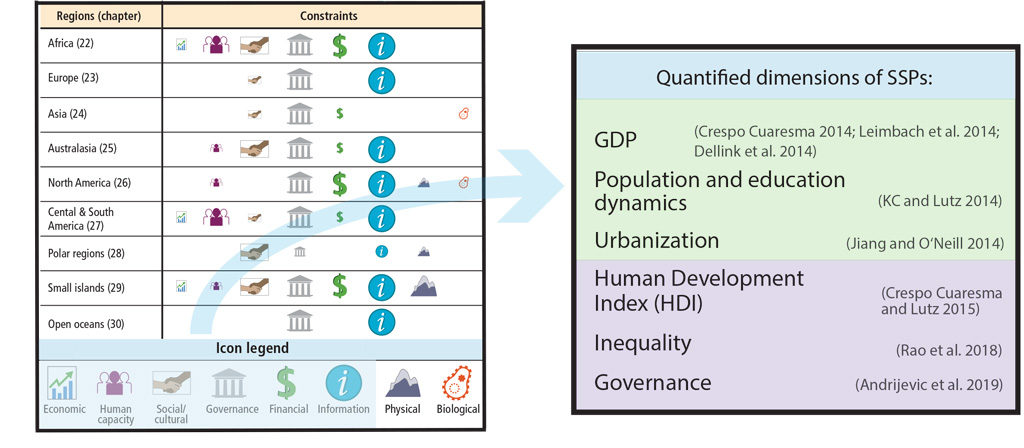
“Parties hereby establish the global goal on adaptation of enhancing adaptive capacity, strengthening resilience and reducing vulnerability to climate change, with a view to contributing to sustainable development and ensuring an adequate adaptation response in the context of the temperature goal referred to in Article 2.”
can hindercorrosive for governanceformation of human capitalmore likely to receive adaptation aid§ An indicator for adaptive capacity over the 21st century
Worldwide Governance Indicatorseconometric modelresearchample empirical evidenceSustainable Development Goals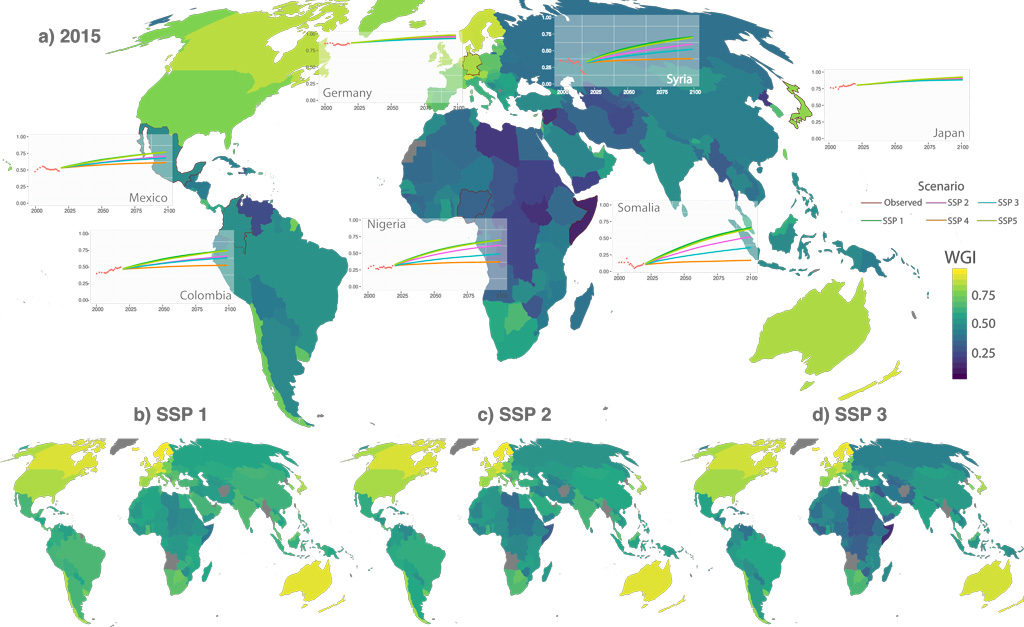
§ The evolution of adaptive capacity and its relevance for loss and damage
special report on global warming of 1.5Cclimate impacts between 1.5C and 2Closs and damageArticle information
Andrijevic, M. et al. (2019) Governance in socioeconomic pathways and its role for future adaptive capacity, Nature Sustainability, doi:10.1038/s41893-019-0405-0