Guest post: Ten ways to use CO2 and how they compare
Can we turn CO2, the waste gas largely responsible for global warming, into a valuable feedstock? The question first emerged in the oil crisis of the 1970s, when alternatives to scarce oil were being sought.The idea has resurfaced on the wave of circular economic thinking, triggered by climate concerns and with a view towards incentivising carbon capture. But opinions on CO2 utilisation veer between scepticism and enthusiasm (pdf).New approaches are constantly arising. Claims of “CO2 avoided”, “CO2 removed” or “reduced CO2 emissions” are easily confusable, and corporations and governments are starting to invest in various candidate technologies without having the big picture to hand.In a new Nature perspective, we set out to pin down what CO2 utilisation is, how it might relate to CO2 removals and emission reductions, and whether such technologies are profitable or scalable.As a team, we represent economists, engineers, chemists, soil scientists and climate modellers – the whole spectrum of views on utilisation. Our study is the most comprehensive to date on the relative scale and costs of different ways to use CO2.§ What is CO2 utilisation?
CO2 utilisationenhanced oil recoverysoil carbon sequestration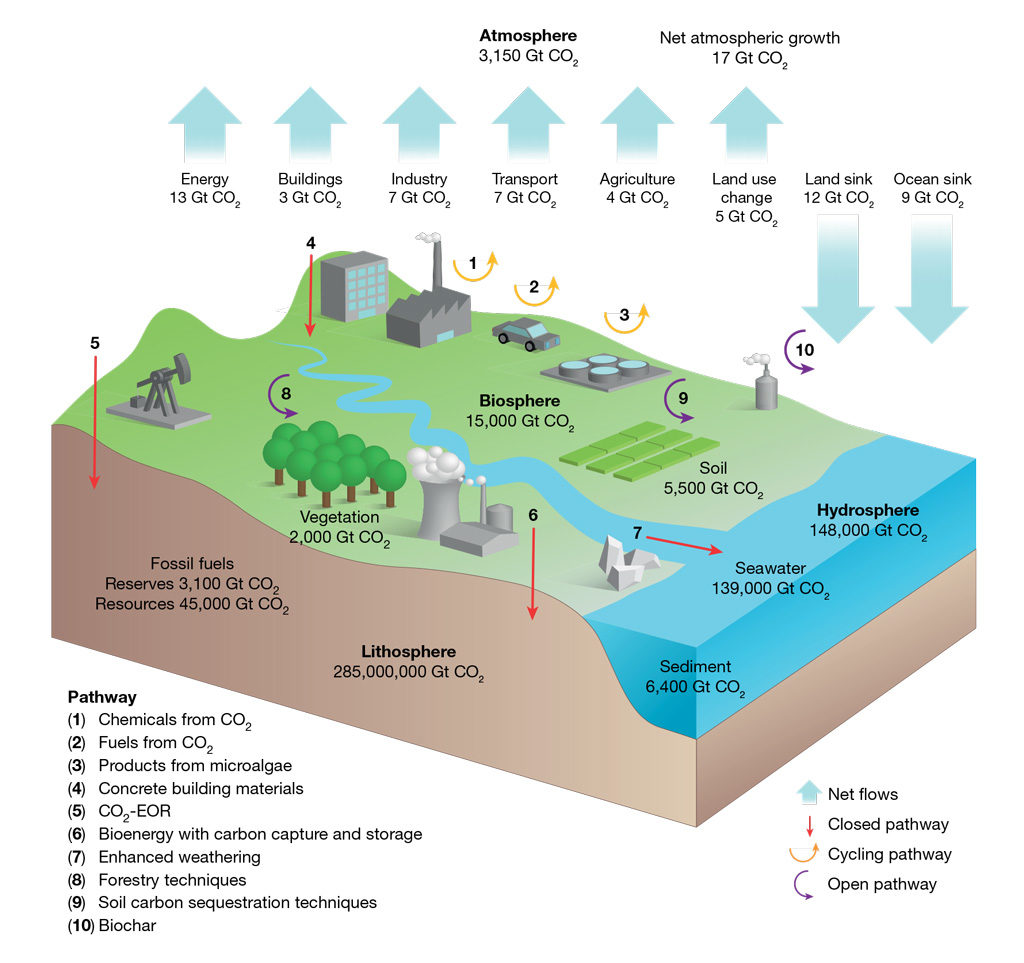
§ How might CO2 utilisation help with climate mitigation?
global emissionsdirect and indirect land-use change- Energy source: CO2 utilisation technologies can be energy-intensive. This energy needs to be renewable: either directly from the sun, or via renewable technologies.
- Broader decarbonisation context: Some of these technologies only make sense as mitigation strategies at certain points of the global decarbonisation process. For example, using enhanced oil recovery to sequester CO2 could be used in the short term before the energy and transport systems are decarbonised.
- Scale: In order to make an appreciable difference to the global flows of CO2, pathways need to have the potential to scale quickly. The window for climate action is small and building an entirely new CO2 utilisation industry in the time needed is a non-trivial challenge.
- Permanence: The most impactful technologies will be the ones that permanently remove atmospheric CO2 or permanently displace CO2 emissions.
§ The 10 pathways and their prospects
structured estimatesinterquartile rangesCO2 chemicalsCO2 fuelssynfuelssyngasMicroalgaemicroalgaefor many yearsConcrete building materialschallenging regulatory environmentCO2-enhanced oil recovery (EOR)it is possibleBioenergy with carbon capture and storage (BECCS)level of deployment that is cognisantEnhanced weatheringCrushing rocksForestrySoil carbon sequestrationBiochar§ Overall potential
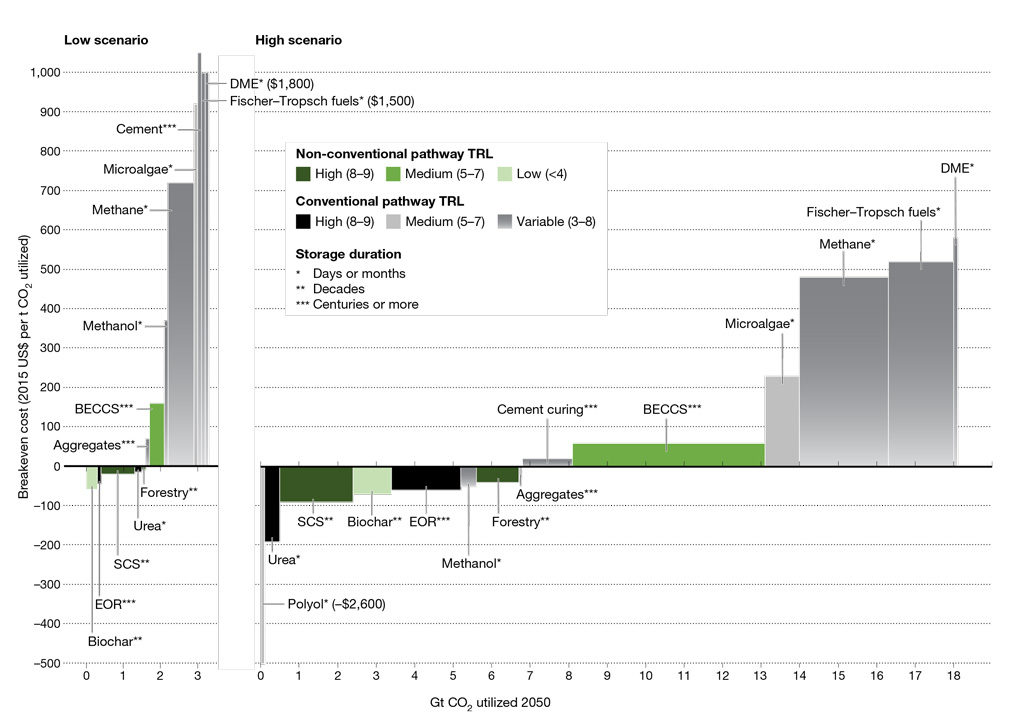
Article information
Hepburn, C. et al. (2019) The technological and economic prospects for CO2 utilization and removal, Nature, doi:s41586-019-1681-6