Guest post: Reducing material use could cut emissions from cars and homes by at least a third
Producing the steel, concrete and other materials that go into our cars and homes accounts for a quarter of all greenhouse gases, so using these things more efficiently has significant potential for emissions cuts.
In our recent study, published in Nature Communications, we found that constructing lighter and smaller products, combined with more intense material use and some behavioural shifts, could cut emissions from these sectors by between one and two thirds.
What is more, making these changes does not require any technological breakthroughs – just willingness among politicians and citizens.
We investigated the production, use and disposal of residential buildings and vehicles in the period up to 2050, exploring different assumptions about demand, population size and climate policies.
Our modelling shows how material efficiency can deliver savings on top of energy efficiency and low-carbon energy supply, making it the third pillar of deep decarbonisation for these sectors.
§ Different futures
The construction sector is responsible for 40% of material-related carbon dioxide (CO2) emissions. We chose to focus on residential buildings because they are the largest energy and material consumers in this sector.
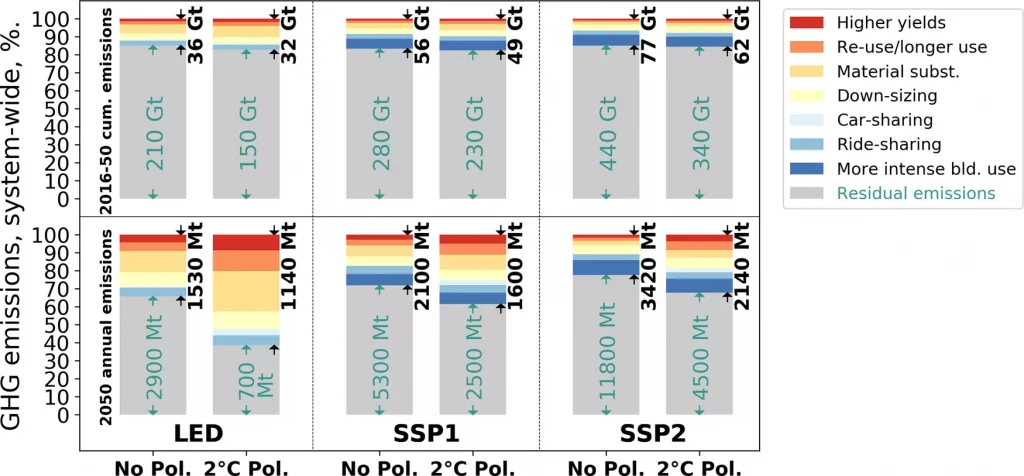
We found that reducing the amount of materials used in house construction, known as “dematerialisation”, could cut emissions by a cumulative total of 20-50bn tonnes of CO2 equivalent (GtCO2e) by 2050.
The cumulative impact of such strategies over the coming decades can be seen in the red, orange and yellow sections of the top row of charts below, under three different future scenarios – Low Energy Demand, Shared Socioeconomic Pathway 1 (SSP1) and SSP2.
The outcome of material efficiency strategies also depend on future climate policies. We compared scenarios in which more clean energy and electric cars keep warming within the 2C goal of the Paris Agreement, to those without additional climate policies beyond what is already in place. These alternatives are marked “2C Pol” and “No Pol” in the chart below.
The blue sections of the chart show the impacts of material efficiency interventions in the manufacturing sector, which accounts for another 40% of material-related CO2 emissions. Passenger vehicles account for most of the consumption in this sector and we found that emissions related to cars could be reduced by a cumulative total of 13-26GtCO2e during the same period out to 2050.
§ More than recycling
Overall, the strategies we investigated would substantially reduce the demand from these two sectors for the “primary” materials produced from natural resources.
Primary steel demand would drop to a sixth, cement demand to a quarter and copper demand would halve, compared with the levels needed without material efficiency interventions (dark solid versus dark dashed lines in the chart, respectively).
These materials would largely be replaced by recycled – or “secondary” – materials, something that can be seen in the chart below (bright lines).
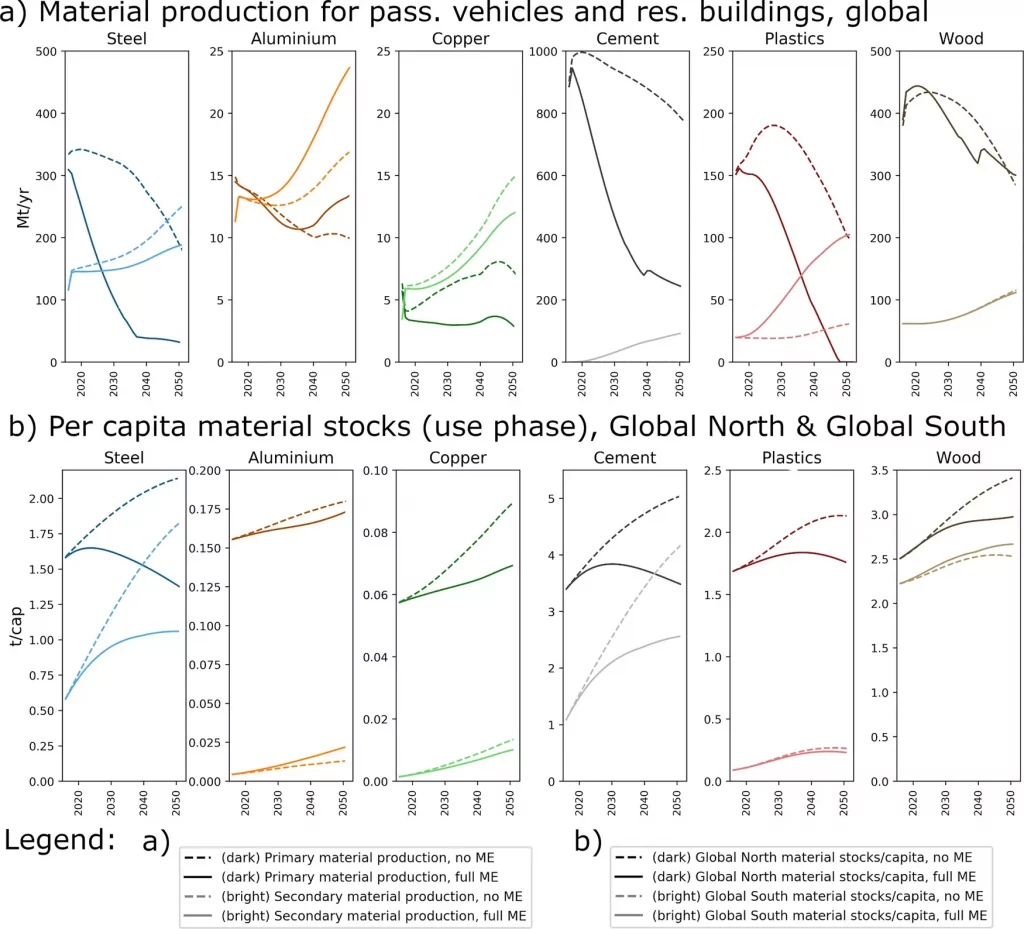
For those promoting the circular economy, this would be a significant development. However, we also showed that cutting overall demand for new products and therefore materials is at least as important as increasing recycling, especially for establishing co-benefits between circular economy and climate change mitigation.
For this research, we built a new model that traces product vintages, their composition and operational characteristics from production through use and maintenance, and ultimately to the end-of-life where the materials become available for recycling.
This model was first applied to the G7 countries in a report for the International Resource Panel, which has informed the formation of the EU’s Circular Economy Action Plan and its Renovation Wave.
The research also shows that, in absolute terms, emissions cuts from dematerialisation in developing countries are much larger than those in industrialised countries. Realising some of these gains is perhaps not trivial in terms of policy innovations, but it requires no technical breakthroughs. In fact, the technologies are all in place and we could begin making the gains identified by our research almost at once.
Article information
Pauliuk, S. et al. (2021) Global scenarios of resource and emission savings from material efficiency in residential buildings and cars, Nature Communications, doi: 10.1038/s41467-021-25300-4