IPBES: Four key takeaways on how nature loss threatens the global economy
The “undervaluing” of nature by businesses is fuelling its decline and putting the global economy at risk, according to a major new report.
An assessment from the Intergovernmental Science-Policy Platform on Biodiversity and Ecosystem Services (IPBES) outlines more than 100 actions for measuring and reducing impacts on nature across business, government, financial institutions and civil society.
A co-chair of the assessment says that nature loss is one of the most “serious threats” to businesses, but the “twisted reality is that it often seems more profitable to businesses to degrade biodiversity than to protect it”.
The “business and biodiversity” report says that global “finance flows” of more than $7tn (£5.1tn) had “direct negative impacts on nature” in 2023.
The new findings were put together by 79 experts from around the world over the course of three years, in what IPBES described as a “fast-track” assessment.
IPBES is an independent body that gives scientific advice to policymakers about biodiversity and ecosystems.
This is the “first report of its kind” to provide guidance on how businesses can contribute to 2030 nature goals, says IPBES executive secretary Dr Luthando Dziba in a statement.
Below, Carbon Brief explains four key findings from the “summary for policymakers” (SPM), which outlines the main messages of the report.
The full report is due to be released in the coming months after final edits are made.
- Businesses both depend on, and harm, nature
- Current practices ‘do not support’ efforts to halt and reverse biodiversity loss
- Businesses can act now to address their impacts on nature
- Government policies can drive a ‘just and sustainable future’ for nature and people
§ 1. Businesses both depend on, and harm, nature
Businesses of all sizes rely on nature in one way or another, says the report.
The SPM outlines that biodiversity provides many of the goods and services businesses need, such as raw materials from the environment or controlled water flows to reduce flooding during wet seasons and provide water in dry seasons.
Biodiversity also “underpins genetic diversity” that informs the development of products in many industries, including pharmaceuticals and cosmetics.
Individual businesses often do not address their impacts and dependencies on nature, “in part due to their lack of awareness”, the SPM says.
They also often do not have the data or knowledge to “quantify their impacts on dependencies on biodiversity and much of the relevant scientific literature is not written for a business audience”, the report claims. It adds:
“Lack of transparency across value chains, including of the risks and opportunities related to the sustainability of resource extraction, use, reuse and waste management, is a further barrier to action.”
The report says it is well established that businesses depend on biodiversity, but also that the actions of businesses “continue to drive declines in biodiversity and nature’s contributions to people”.
(IPBES says it uses terms such as well established to express “how assured experts are about the findings”. Well established findings, the highest level of confidence, have significant evidence and high agreement behind them. The three other terms used in IPBES reports are: unresolved (a lot of evidence but low agreement), established but incomplete (limited evidence but good agreement) and inconclusive (limited or no evidence and little agreement).)
The report notes that the size of a business “does not always reflect the magnitude of its impacts”, with companies in sectors such as agriculture, forestry, fishing, electricity, energy and mining having “relatively high” direct impacts on nature.
A “failure” to account for nature as the economy has expanded over the past two centuries has “led to its degradation and unprecedented rates of biodiversity loss”, the SPM says. It adds:
“The decline in biodiversity and nature’s contributions to people has become a critical systemic risk threatening the economy, financial stability and human wellbeing with implications for human rights.”
It is well established that nature loss as a result of “unsustainable use” threatens the “ability of businesses, local economies and whole sectors to function”, the report details.
These risks and others – such as extreme weather events and critical changes to Earth systems – are “among the highest-ranked global risks over the next 10 years”, it adds.
The SPM notes further that it is well established that risks around climate change and biodiversity loss “may interact to amplify social and economic impacts”.
These risks have “disproportionate impacts on developing countries whose economies are more reliant on biodiversity and have more limited technical and financial capacity to absorb shocks”, the report adds.
§ 2. Current practices ‘do not support’ efforts to halt and reverse biodiversity loss
The SPM says that it is well established that current political and economic practices “perpetuate business as usual and do not support the transformative change required to halt and reverse biodiversity loss”.
These practices have “commonly ignored or undervalued biodiversity, creating tension between business actions and the conservation and sustainable use of biodiversity”, the report continues.
For example, the report says there is established but incomplete evidence that “time pressures on decision-making and timescales for investment returns and reporting by businesses – with an emphasis on quarterly earnings or annual reporting – are shorter than many ecological cycles”.
This prevents businesses from “adequately” considering nature loss in decision-making, says the SPM.
There is well established evidence that businesses fail to assign adequate value to “biodiversity and many of nature’s contributions to people, such as filtration of pollutants, climate regulation and pollination”, it continues.
As a result, “businesses bear little or no financial cost for negative impacts and may not generate revenue from positive impacts on biodiversity”, leading to “insufficient incentives for businesses to act to conserve, restore or sustainably use biodiversity”.
Prof Stephen Polasky, co-chair of the assessment and a professor of ecological and environmental economics at the University of Minnesota, said in a statement:
“The loss of biodiversity is among the most serious threats to business. Yet the twisted reality is that it often seems more profitable to businesses to degrade biodiversity than to protect it. Business as usual may once have seemed profitable in the short term, but impacts across multiple businesses can have cumulative effects, aggregating to global impacts, which can cross ecological tipping points.”
It is well established that policies from governments can “further accelerate biodiversity decline”, the SPM says.
It notes that, in 2023, global public and private financial spending with direct negative impacts on nature was estimated at $7.3tn.
This figure includes public subsidies that are harmful to nature (around $2.4tn) and private investment in high-impact sectors ($4.9tn), says the report.
Industries harmful to nature include fossil-fuel extraction, mining, deforestation and large-scale meat farming and fishing.
In contrast, just $220bn in public and private finance was directed to activities that contribute to protecting and sustainably using nature in 2023, adds the report.
(In recognition of the need to address public spending on activities that are destructive to nature, countries agreed to reduce biodiversity-harming subsidies by at least $500bn by 2030 as part of a global pact made in 2022.)
There are additional “barriers to action” facing businesses, ranging from challenging social norms to a lack of capacity, data or technology. These are summarised in the table below.
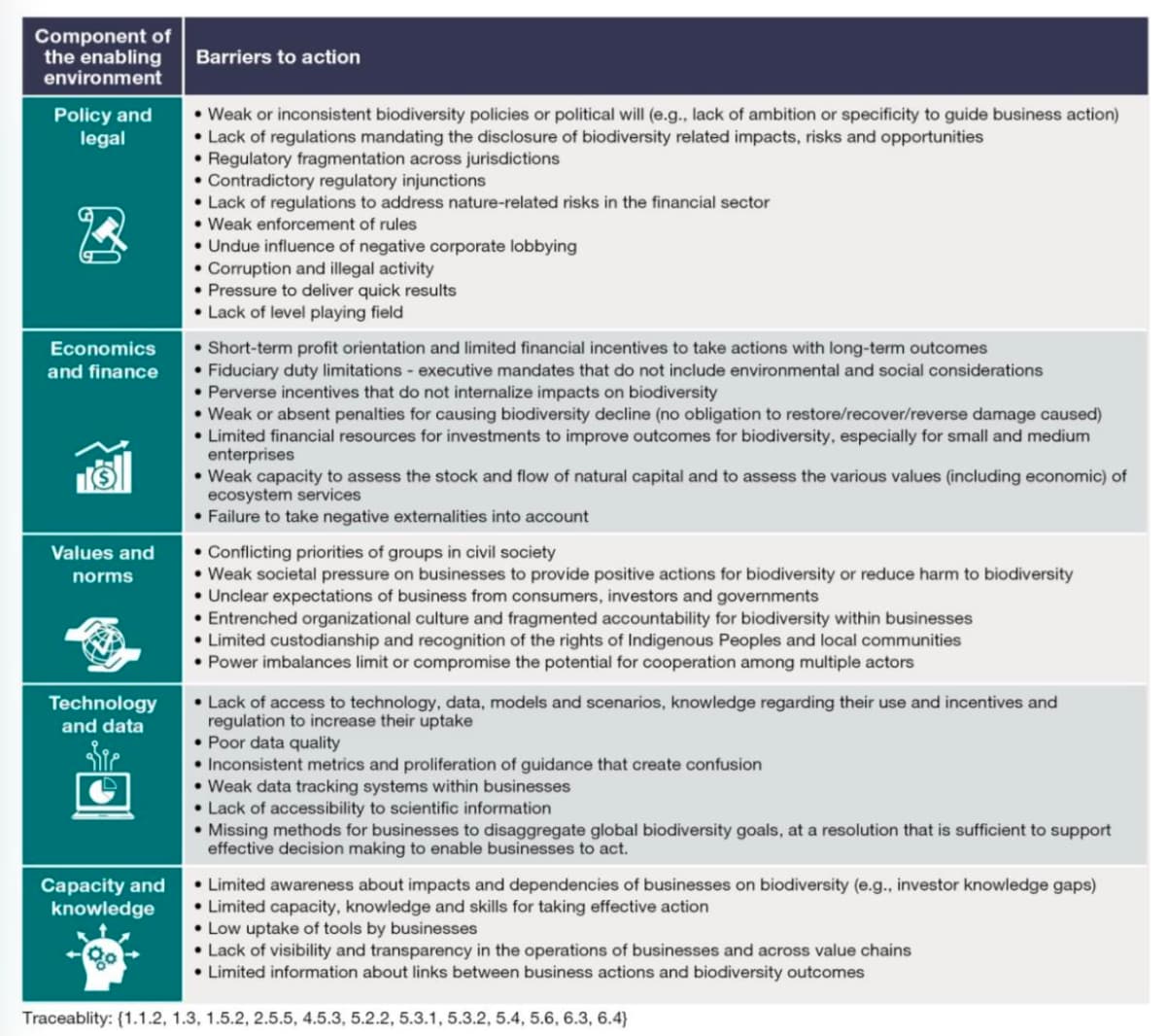
“These barriers do not affect all actors equally and may disproportionately affect small and medium-sized businesses and financial institutions in developing countries,” adds the report.
§ 3. Businesses can act now to address their impacts on nature
The SPM says it is well established that the “transformative change” required to halt and reverse biodiversity loss requires action from “all businesses”.
However, the report continues that it is also well established that the current level of business action is “insufficient” to deliver this “transformative change”. This is, in part, because the “enabling environment is missing”, it says.
IPBES says all businesses have a responsibility to act, even if this responsibility is not shared “evenly”.
“Priority actions” that businesses should take differ depending on the size of the firm, the sector in which it operates in, as well as the company structure and its “relationship with biodiversity”, the report notes.
The exact actions businesses should pursue also depends on companies’ “degree of control and influence over stakeholders”, it says.
According to the report, firms can act across four “decision-making levels” – corporate, operations, value chain and portfolio – to measure and address impacts on biodiversity.
(“Corporate” refers to decisions focused on overarching strategy, governance and direction of the business; “operations” to day-to-day activities; “value chain” to the system and resources required to move a product or service from supplier to customer; and “portfolio” to investments and business assets).
The SPM sets out a series of examples for how businesses can act across all four levels. These are summarised in the table below.
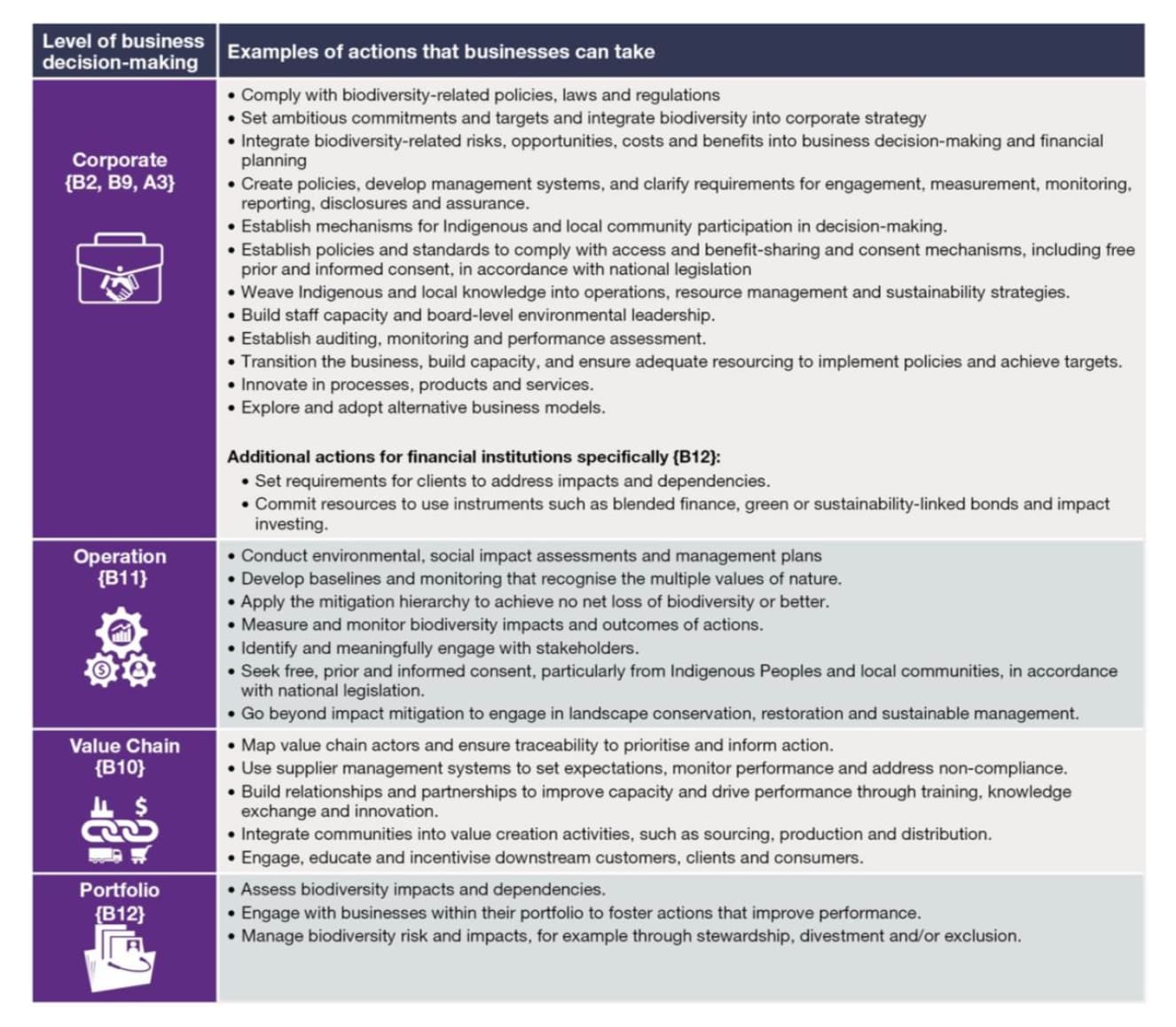
At a corporate level, the report notes that firms can establish ambitious governance and frameworks that can then have a ripple effect across the other levels, according to the report. This includes the integration of biodiversity commitments and targets into corporate strategy.
The SPM says that corporate biodiversity targets are “most effective” when they are aligned with “national and global biodiversity objectives” and “take into consideration a business’s impacts and dependencies on biodiversity and nature’s contributions to people”.
At an operations level, businesses should focus on ensuring that their operations are located and managed in a way that benefits biodiversity, IPBES says. Environmental and social impact assessments and management plans that are supported by “credible monitoring of both actions and biodiversity outcomes” can underpin this effort, the SPM notes.
It says it is well established that using the “mitigation hierarchy” framework can help businesses deliver “lasting outcomes on the ground”. (The framework guides users towards limiting as far as possible the negative impacts on biodiversity from development projects by first avoiding, then minimising, restoring and offsetting impacts.)
Next, the report notes there are actions businesses can take to drive change within its broader spheres of influence, including suppliers, retailers, consumers and peers within industry. This is important, the SPM notes, as significant impacts and dependencies on biodiversity and nature “accrue” across the lifecycle of products or services, especially those that rely on raw materials.
The report notes there is established but incomplete evidence that efforts to “map” company value chains and improve traceability by linking products and materials to suppliers, locations and impacts can help “identify risks and prioritise actions”.
While noting that “mapping” beyond direct suppliers “often remains challenging” for businesses, the report adds:
“Examples at the corporate and value chain levels exist, such as companies in the chocolate industry that have made advances in recording biodiversity dependencies to improve business decisions through full traceability of materials and improved supplier control mechanisms.”
Elsewhere, the SPM notes that there is also established but incomplete evidence that consumer-focused measures – such as product labelling, education and incentives – can “shape behaviour and improve transparency”. However, it cautions that the effectiveness of these strategies is “constrained by consumer scepticism, certification costs and business models reliant on unsustainable consumption”.
The SPM also highlights that, at a “portfolio” level, financial institutions can shift finance away from harmful activities – for instance, companies whose products drive deforestation – and towards business activities with positive impacts for biodiversity and nature.
Speaking to Carbon Brief, Matt Jones, co-chair of the report, explains the rationale behind including options for how businesses can address biodiversity impacts in the document:
“Businesses and governments in different countries are coming at this from a very different perspective. So we can’t present a set of really prescriptive ‘how tos’…but we can present a huge number of options for action that businesses, governments, financial institutions and civil society and other actors can all take.”
Elsewhere, the report says it is well established that “robust, transparent and credible reporting of actions and outcomes” is required to “inspire others”.
§ 4. Government policies can drive a ‘just and sustainable future’ for nature and people
Both governments and financial institutions can set policies and create incentives to protect biodiversity and stem its decline, says the SPM.
According to the report, the types of policies that governments can put in place that have an influence over business include:
- Fiscal policies, such as subsidies and taxes.
- Land use or marine spatial planning and zoning, such as designating new national parks or areas protected for nature.
- Permitting for business activities that affect nature – for example, by requiring environmental impact assessments.
- Public procurement policy (rules for how governments purchase goods and services).
- Controls on advertising and the creation of standards to prevent “greenwashing”.
Governments can also promote action through paying for ecosystem services, creating environmental markets and through “multilateral benefit-sharing mechanisms”, which set out rules for ensuring profits from nature are shared equally, says the SPM.
It says this includes the Cali Fund, a fund that businesses can voluntarily pay into after reaping benefits from genetic resources found in biodiverse countries.
(The fund was agreed in 2024 with expectations that it could generate up to billions of dollars for conservation, but it has so far only attracted $1,000.)
Governments could also promote action by phasing out or reforming subsidies that are harmful for nature, as well as fostering positive incentives, according to the report.
Overall, governments can work with other actors to create an “enabling environment” to “incentivise actions that are beneficial for businesses, biodiversity and society for a just and sustainable future”, says the SPM. It adds:
“Creation of an enabling environment that provides incentives for the conservation and sustainable use of biodiversity and nature’s contributions to people could align what is profitable with what is good for biodiversity and society.
“Creating this enabling environment would result in businesses and financial institutions being positive agents of change in transforming to a just and sustainable economic system, by addressing their impacts on biodiversity loss, climate change and pollution, which are all interconnected.”