DeBriefed 13 February 2026: Trump repeals landmark ‘endangerment finding’ | China’s emissions flatlining | UK’s ‘relentless rain’
Welcome to Carbon Brief’s DeBriefed.
An essential guide to the week’s key developments relating to climate change.
§ This week
Landmark ruling repealed
DANGER DANGER: The Trump administration formally repealed the US’s landmark “endangerment finding” this week, reported the Financial Times. The 2009 Obama-era finding concluded that greenhouse gases pose a threat to public health and has provided a legal basis for their regulation over the past two decades, said the New York Times.
RACE TO COURT: Multiple environmental groups have already threatened to sue over the administration’s decision, reported the Guardian. The fate of the ruling is likely to ultimately be decided by the Conservative-majority Supreme Court, explained the New York Times.
‘BEAUTIFUL CLEAN COAL’: Separately, Donald Trump signed an executive order requiring the Pentagon to buy coal-fired power, a move aimed to “revive a fuel source in sharp decline”, reported the Los Angeles Times. Despite his efforts, Trump has overseen more retirements of coal-fired power stations than any other US president, according to Carbon Brief analysis.
§ Around the world
- CLIMATE TALKS: UN climate chief Simon Stiell said in a speech on Thursday that climate action can deliver stability in the face of a “new world disorder“ while on a visit to Turkey, which will host the COP31 climate summit later this year, reported BusinessGreen.
- IBERIAN CATASTROPHE: A succession of storms that hit Spain and Portugal in recent weeks have caused millions of euros worth of damage to farmlands and required more than 11,000 people to leave their homes in Spain’s southern Andalusia region, said Reuters.
- RISKY BUSINESS: The “undervaluing” of nature by businesses is fuelling its decline and putting the global economy at risk, according to a new report by the Intergovernmental Science-Policy Platform on Biodiversity and Ecosystem Services (IPBES), covered by Carbon Brief. Carbon Brief interviewed IPBES chair Dr David Obura at the report’s launch in Manchester.
- CORAL BLEACHING: A study covered by Agence France-Presse found that more than half of the world’s coral reefs were bleached over a three-year period from 2014-17 during Earth’s third “global bleaching event”. The world has since entered a fourth bleaching event, starting in 2023, a scientist told AFP.
- ‘HELLISH HOTHOUSE EARTH’: In a commentary paper, scientists argued that the world is closer than thought to a “point of no return”, which could plunge Earth into a “hellish hothouse” state, reported the Guardian.
§ 7.4 gigawatts
The record amount of solar, onshore wind and tidal power secured in the latest auction for new renewable capacity in the UK, reported Carbon Brief.
§ Latest climate research
- Human-caused climate change made the hot, dry and windy weather in Chile and Argentina three times more likely | World Weather Attribution (Carbon Brief also covered the study)
- “Early-life” exposure to extreme heat “increases risk” of neurodevelopmental delay in preschool children | Nature Climate Change
- Climate change, urbanisation and species characteristics shape European butterfly population trends | Global Ecology and Biogeography
(For more, see Carbon Brief’s in-depth daily summaries of the top climate news stories on Monday, Tuesday, Wednesday, Thursday and Friday.)
§ Captured
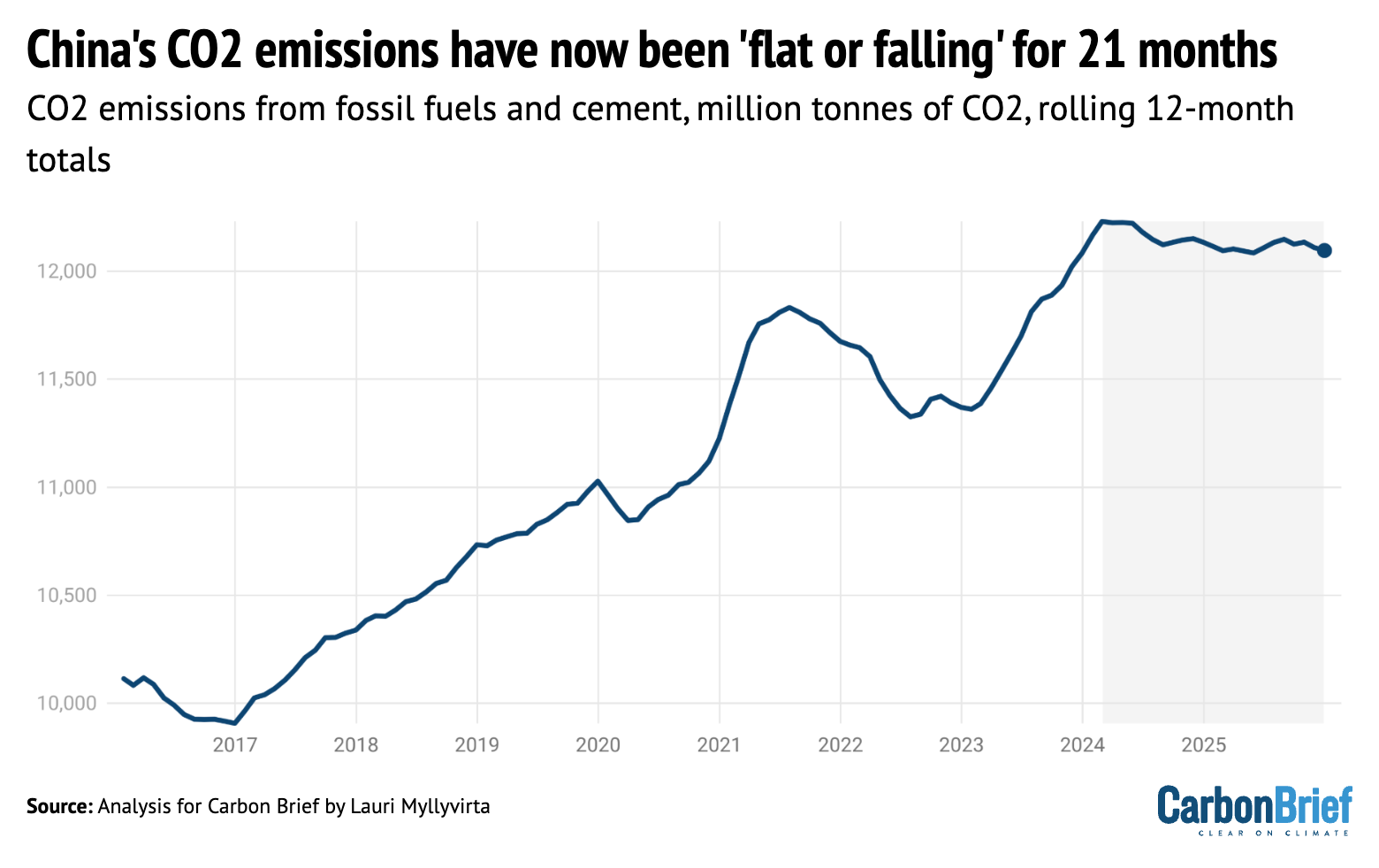
China’s carbon dioxide emissions have “now been flat or falling for 21 months”, analysis for Carbon Brief has found. The trend began in March 2024 and has lasted almost two years, due in particular to falling emissions in major sectors, including transport, power and cement, said the analysis. The analysis has been covered widely in global media, including Agence France-Presse, Bloomberg, New York Times, BBC World Service and Channel 4 News.
§ Spotlight
UK’s ‘relentless rain’
This week, Carbon Brief takes a deep dive into the recent relentless rain and floods in the UK and explores how they could be linked to climate change.
It is no secret that it can rain a lot in the UK. But, in some parts of the country, it has rained every day of the year so far, according to Met Office data released this week.
In total, 26 stations set new monthly rainfall records for January. Northern Ireland experienced its wettest January for 149 years and Plymouth, in the south-west of England, experienced its wettest January day in 104 years.
Areas witnessing long periods of rain included Bodmin Moor in Cornwall, which has seen 41 consecutive days of rain “and counting”, reported the Guardian. The University of Reading found that its home town had its longest period of consecutive rain – 25 days – since its records for the city began in 1908.
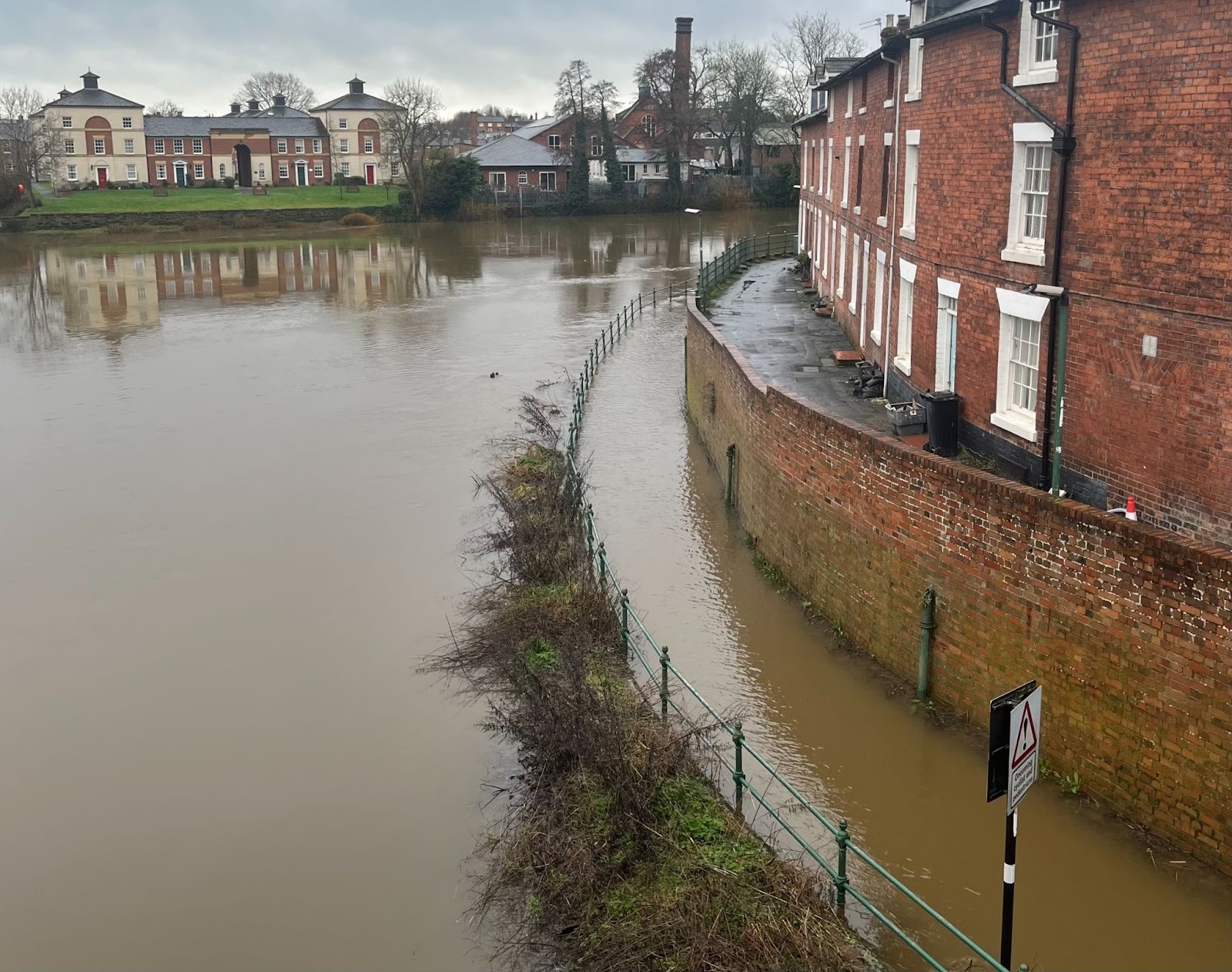
The relentless rainfall has caused flooding in many parts of the country, particularly in rural areas.
There were more than 200 active flood alerts in place across England and Wales at the weekend, with flood warnings clustered around Gloucester and Worcester in the West Midlands, as well as Devon and Hampshire in southern England. A flood “alert” means that there is a possibility of flooding, while a “warning” means flooding is expected.
“Growing up, the road to my school never flooded. But the school has already had to close three times this year because of flooding,” Jess Powell, a local resident of a small village in Shropshire, told Carbon Brief.
Climate link
While there has not yet been a formal analysis into the role of climate change in the UK’s current lengthy period of rain and flooding, it is known that human-caused warming can play a role in wet weather extremes, explained Dr Jess Neumann, a flooding researcher from the University of Reading. She told Carbon Brief:
“Warmer air can hold more moisture – about 7% more for every 1C of warming, increasing the chance of more frequent and at times, intense rainfall.”
The UK owes its rainy climate in large part due to the jet stream, which brings strong winds from west to east and pushes low-pressure weather systems across the Atlantic.
Scientists have said that one of the factors behind the UK’s relentless rain is the “blocking” of the jet stream, which occurs when winds slow, causing rainy weather patterns to get stuck.
The impact of climate change on the jet stream is complex, involving a lot of different factors. One theory, still subject to debate among scientists, is that Arctic warming could play a role, explained Neumann:
“As the Arctic warms faster than the tropics, the temperature gradient that fuels the jet stream weakens, causing it to become slower and wavier. Blocking patterns develop that can cause weather conditions to get stuck over the UK, increasing the likelihood of extreme rainfall and flooding.”
Adaptation needs
Long periods of rain saturate the ground and can have adverse impacts on agriculture and wildlife.
Prof Richard Betts, a leading climate scientist at the Met Office and the University of Exeter, said that these impacts can have harmful effects in rural areas:
“The climate change-driven increase in flood risk is impacting food production in the UK. In 2024, the production of wheat, barley, oats and oilseed rape shrunk by 13% due to widespread flooding of farmland.
“Assistance with recovery after flooding is increasingly important – obviously, financial help via insurance and reinsurance is vital, but also action to reduce impacts on mental health is increasingly important. It’s very stressful dealing with the impacts of flooding and this is often not recognised.”
One key adaptation for floods in the UK could be to “integrate natural flood management, including sustainable urban drainage, with more traditional hard engineering techniques”, added Neumann:
“Most importantly, we need to improve our communication of flood risk to help individuals and communities know how to prepare. We need to shift our thinking from ‘keeping water out’ to ‘living with water’, if we want to adapt better to a future of flooding.”
§ Watch, read, listen
‘IRREVERSIBLE TREND?’: The Guardian explored how Romania’s emissions have fallen by 75% since the 1990s and have been decoupled from the country’s economic growth.
UNDER THE SEA: An article in BioGraphic explored whether the skeletons of dead corals “help or hinder recovery” on bleached reefs.
SPEEDING UP: Through dynamic charts, the Washington Post showed how climate change is accelerating.
§ Coming up
- 16-19 February: Sixth meeting of the subsidiary body on implementation of the Convention on Biological Diversity, Rome, Italy
- 20 February: Webinar on the key findings from the International Energy Agency policy brief: the value of demand flexibility: benefits beyond balancing
- 20 February: UN day of social justice
- 22-27 February: Ocean Sciences Meeting, Glasgow, UK
§ Pick of the jobs
- UN Food and Agriculture Organisation (FAO), national senior climate change expert | Salary: Unknown. Location: Dhaka, Bangladesh
- British Antarctic Survey, marine biologist | Salary: £31,183. Location: Antarctica
- Green Climate Fund, regional lead for resource mobilisation – Europe | Salary: $109,000. Location: Seoul, South Korea
- Scientific American, documentary film proposals | Up to $80,000 per commissioned film
DeBriefed is edited by Daisy Dunne. Please send any tips or feedback to debriefed@carbonbrief.org.
This is an online version of Carbon Brief’s weekly DeBriefed email newsletter. Subscribe for free here.