DeBriefed 20 February 2026: EU’s ‘3C’ warning | Endangerment repeal’s impact on US emissions | ‘Tree invasion’ fuelled South America’s fires
Welcome to Carbon Brief’s DeBriefed.
An essential guide to the week’s key developments relating to climate change.
§ This week
Preparing for 3C
NEW ALERT: The EU’s climate advisory board urged countries to prepare for 3C of global warming, reported the Guardian. The outlet quoted Maarten van Aalst, a member of the advisory board, saying that adapting to this future is a “daunting task, but, at the same time, quite a doable task”. The board recommended the creation of “climate risk assessments and investments in protective measures”.
‘INSUFFICIENT’ ACTION: EFE Verde added that the advisory board said that the EU’s adaptation efforts were so far “insufficient, fragmented and reactive” and “belated”. Climate impacts are expected to weaken the bloc’s productivity, put pressure on public budgets and increase security risks, it added.
UNDERWATER: Meanwhile, France faced “unprecedented” flooding this week, reported Le Monde. The flooding has inundated houses, streets and fields and forced the evacuation of around 2,000 people, according to the outlet. The Guardian quoted Monique Barbut, minister for the ecological transition, saying: “People who follow climate issues have been warning us for a long time that events like this will happen more often…In fact, tomorrow has arrived.”
IEA ‘erases’ climate
MISSING PRIORITY: The US has “succeeded” in removing climate change from the main priorities of the International Energy Agency (IEA) during a “tense ministerial meeting” in Paris, reported Politico. It noted that climate change is not listed among the agency’s priorities in the “chair’s summary” released at the end of the two-day summit.
US INTERVENTION: Bloomberg said the meeting marked the first time in nine years the IEA failed to release a communique setting out a unified position on issues – opting instead for the chair’s summary. This came after US energy secretary Chris Wright gave the organisation a one-year deadline to “scrap its support of goals to reduce energy emissions to net-zero” – or risk losing the US as a member, according to Reuters.
§ Around the world
- ISLAND OBJECTION: The US is pressuring Vanuatu to withdraw a draft resolution supporting an International Court of Justice ruling on climate change, according to Al Jazeera.
- GREENLAND HEAT: The Associated Press reported that Greenland’s capital Nuuk had its hottest January since records began 109 years ago.
- CHINA PRIORITIES: China’s Energy Administration set out its five energy priorities for 2026-2030, including developing a renewable energy plan, said International Energy Net.
- AMAZON REPRIEVE: Deforestation in the Brazilian Amazon has continued to fall into early 2026, extending a downward trend, according to the latest satellite data covered by Mongabay.
- GEZANI DESTRUCTION: Reuters reported the aftermath of the Gezani cyclone, which ripped through Madagascar last week, leaving 59 dead and more than 16,000 displaced people.
§ 20cm
The average rise in global sea levels since 1901, according to a Carbon Brief guest post on the challenges in projecting future rises.
§ Latest climate research
- Wildfire smoke poses negative impacts on organisms and ecosystems, such as health impacts on air-breathing animals, changes in forests’ carbon storage and coral mortality | Global Ecology and Conservation
- As climate change warms Antarctica throughout the century, the Weddell Sea could see the growth of species such as krill and fish and remain habitable for Emperor penguins | Nature Climate Change
- About 97% of South American lakes have recorded “significant warming” over the past four decades and are expected to experience rising temperatures and more frequent heatwaves | Climatic Change
(For more, see Carbon Brief’s in-depth daily summaries of the top climate news stories on Monday, Tuesday, Wednesday, Thursday and Friday.)
§ Captured
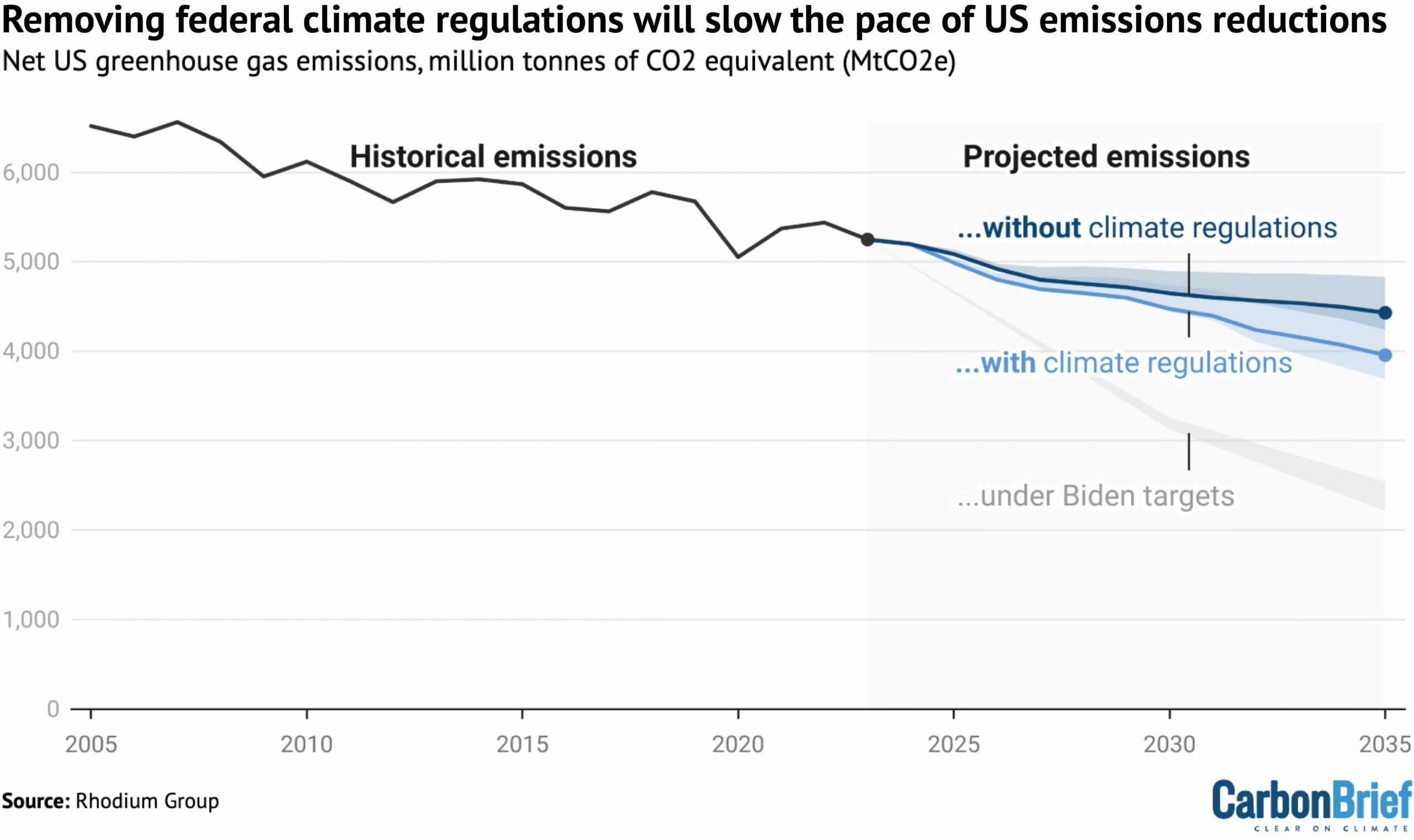
Repealing the US’s landmark “endangerment finding”, along with actions that rely on that finding, will slow the pace of US emissions cuts, according to Rhodium Group visualised by Carbon Brief. US president Donald Trump last week formally repealed the scientific finding that underpins federal regulations on greenhouse gas emissions, although the move is likely to face legal challenges. Data from the Rhodium Group, an independent research firm, shows that US emissions will drop more slowly without climate regulations. However, even with climate regulations, emissions are expected to drop much slower under Trump than under the previous Joe Biden administration, according to the analysis.
§ Spotlight
How a ‘tree invasion’ helped to fuel South America’s fires
This week, Carbon Brief explores how the “invasion” of non-native tree species helped to fan the flames of forest fires in Argentina and Chile earlier this year.
Since early January, Chile and Argentina have faced large-scale and deadly wildfires, including in Patagonia, which spans both countries.
These fires have been described as “some of the most significant and damaging in the region”, according to a World Weather Attribution (WWA) analysis covered by Carbon Brief.
In both countries, the fires destroyed vast areas of native forests and grasslands, displacing thousands of people. In Chile, the fires resulted in 23 deaths.
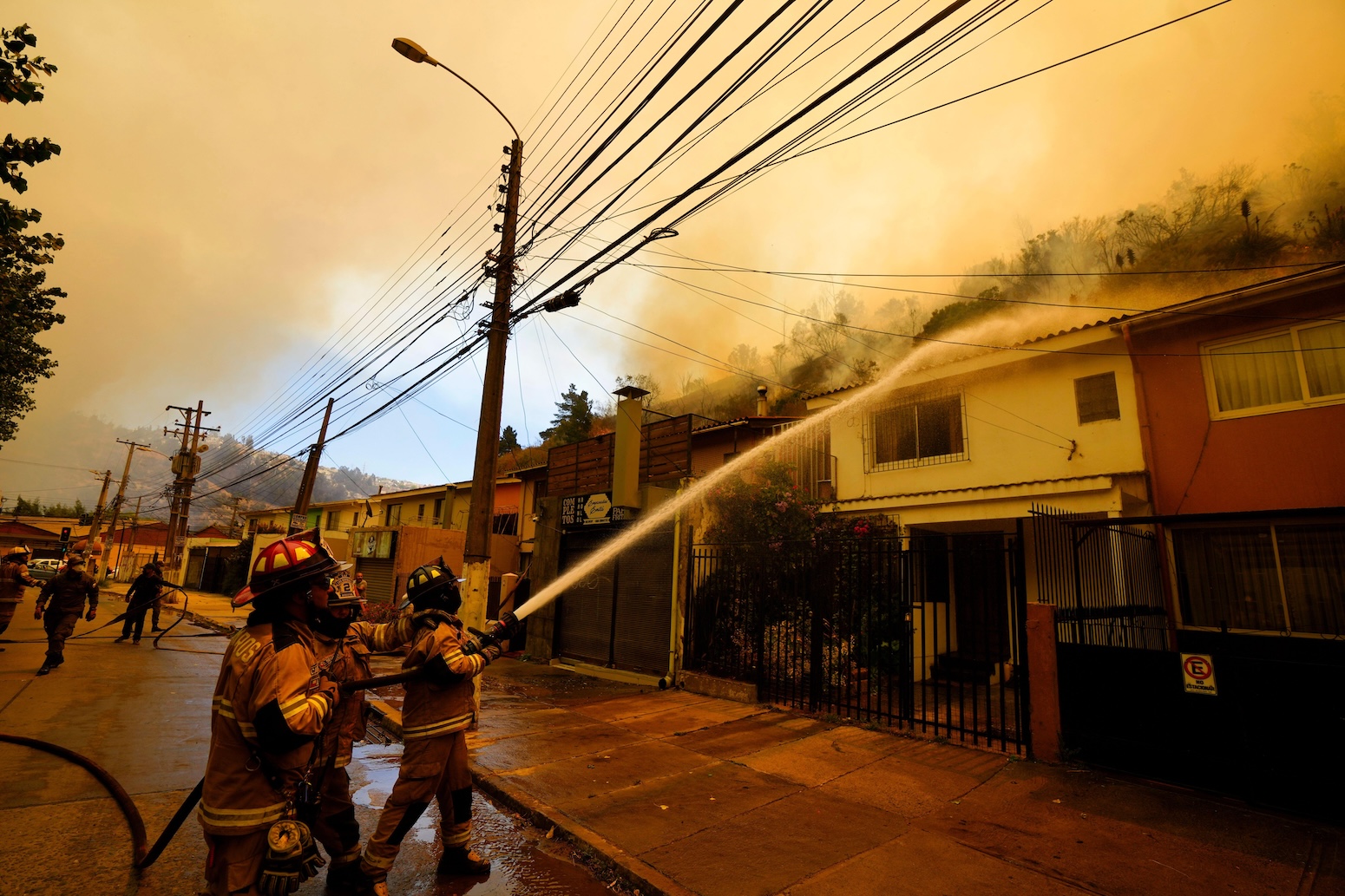
Multiple drivers contributed to the spread of the fires, including extended periods of high temperatures, low rainfall and abundant dry vegetation.
The WWA analysis concluded that human-caused climate change made these weather conditions at least three times more likely.
According to the researchers, another contributing factor was the invasion of non-native trees in the regions where the fires occurred.
The risk of non-native forests
In Argentina, the wildfires began on 6 January and persisted until the first week of February. They hit the city of Puerto Patriada and the Los Alerces and Lago Puelo national parks, in the Chubut province, as well as nearby regions.
In these areas, more than 45,000 hectares of native forests – such as Patagonian alerce tree, myrtle, coigüe and ñire – along with scrubland and grasslands, were consumed by the flames, according to the WWA study.
In Chile, forest fires occurred from 17 to 19 January in the Biobío, Ñuble and Araucanía regions.
The fires destroyed more than 40,000 hectares of forest and more than 20,000 hectares of non-native forest plantations, including eucalyptus and Monterey pine.
Dr Javier Grosfeld, a researcher at Argentina’s National Scientific and Technical Research Council (CONICET) in northern Patagonia, told Carbon Brief that these species, introduced to Patagonia for production purposes in the late 20th century, grow quickly and are highly flammable.
Because of this, their presence played a role in helping the fires to spread more quickly and grow larger.
However, that is no reason to “demonise” them, he stressed.
Forest management
For Grosfeld, the problem in northern Patagonia, Argentina, is a significant deficit in the management of forests and forest plantations.
This management should include pruning branches from their base and controlling the spread of non-native species, he added.
A similar situation is happening in Chile, where management of pine and eucalyptus plantations is not regulated. This means there are no “firebreaks” – gaps in vegetation – in place to prevent fire spread, Dr Gabriela Azócar, a researcher at the University of Chile’s Centre for Climate and Resilience Research (CR2), told Carbon Brief.
She noted that, although Mapuche Indigenous communities in central-south Chile are knowledgeable about native species and manage their forests, their insight and participation are not recognised in the country’s fire management and prevention policies.
Grosfeld stated:
“We are seeing the transformation of the Patagonian landscape from forest to scrubland in recent years. There is a lack of preventive forestry measures, as well as prevention and evacuation plans.”
§ Watch, read, listen
FUTURE FURNACE: A Guardian video explored the “unbearable experience of walking in a heatwave in the future”.
THE FUN SIDE: A Channel 4 News video covered a new wave of climate comedians who are using digital platforms such as TikTok to entertain and raise awareness.
ICE SECRETS: The BBC’s Climate Question podcast explored how scientists study ice cores to understand what the climate was like in ancient times and how to use them to inform climate projections.
§ Coming up
- 22-27 February: Ocean Sciences Meeting, Glasgow
- 24-26 February: Methane Mitigation Europe Summit 2026, Amsterdam, Netherlands
- 25-27 February: World Sustainable Development Summit 2026, New Delhi, India
Pick of the jobs
- The Climate Reality Project, digital specialist | Salary: $60,000-$61,200. Location: Washington DC
- Intergovernmental Panel on Climate Change (IPCC), science officer in the IPCC Working Group I Technical Support Unit | Salary: Unknown. Location: Gif-sur-Yvette, France
- Energy Transition Partnership, programme management intern | Salary: Unknown. Location: Bangkok, Thailand
DeBriefed is edited by Daisy Dunne. Please send any tips or feedback to debriefed@carbonbrief.org.
This is an online version of Carbon Brief’s weekly DeBriefed email newsletter. Subscribe for free here.