China Briefing 5 March 2026: New five-year climate goals revealed at ‘two sessions’ meeting
Welcome to Carbon Brief’s China Briefing.
China Briefing handpicks and explains the most important climate and energy stories from China over the past fortnight. Subscribe for free here.
§ Key developments
Government ‘work report’ for 2026 announced
LOWER GROWTH: China is aiming for economic growth of 4.5-5% in 2026, reported state-run newspaper China Daily in its coverage of the “government work report” – an outline of China’s policies in 2026 delivered by Chinese premier Li Qiang at the annual “two sessions” meeting of key government and party officials in Beijing. This is the lowest target since 1991, said BBC News, as China “grapples with challenges both at home and abroad”. Li said “geopolitical risks are rising”, noted the Financial Times. The lower GDP target reflects a shift to what Beijing calls “high-quality growth”, said the Guardian.
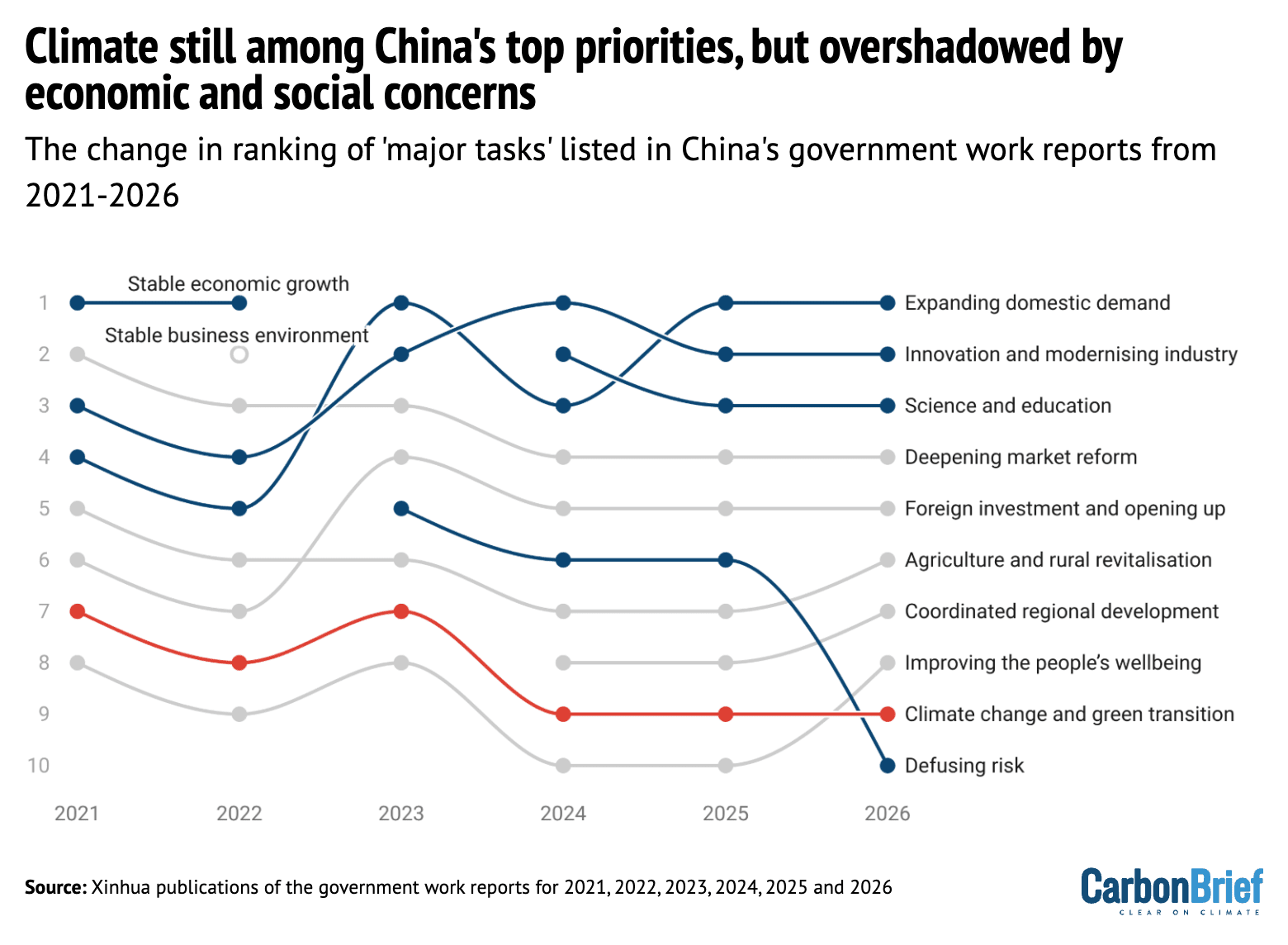
‘GREEN DEVELOPMENT’: The work report cited the publication of China’s 2035 climate pledge under the Paris Agreement as one of the achievements made last year, noted state-run broadcaster CGTN. Another CGTN article said that “new quality productive forces” also “grew steadily” in 2025, referring to a term that includes “green development”. Financial services firm ING said that the report highlighted priorities for 2026 including “high-quality” and “green development”, as well as domestic consumption, but that it also scaled back China’s consumer “trade-in” policy relative to 2025.
‘LAX’ INTENSITY: The report set a target to cut China’s “carbon intensity” – its carbon dioxide (CO2) emissions per unit of GDP – by 3.8% in 2026, reported Reuters, which quoted Lauri Myllyvirta of the Centre for Research on Energy and Clean Air saying this was “alarmingly lax”. He told Carbon Brief that emissions could rise by up to 0.5-1.0% while still meeting this target.
DUAL-CARBON DOUBTS: The work report said that China’s goal of peaking CO2 emissions before 2030 would be “accomplished as planned” and that a system to control the total amount of emissions would also be implemented, said Bloomberg. The report offers little detail on the shift to this system for the “dual control of carbon”, said Greenpeace East Asia’s Yao Zhe in a statement.

TRANSITION FUND: Another China Daily article reported that China will “establish a national fund for low-carbon transition” this year. Citing the work report, it said this fund would be used to “foster new growth drivers such as hydrogen power and green fuels”. The newspaper pointed to other climate-related elements of the report, including promoting the “clean and efficient use of fossil fuels” and “zero-carbon industrial parks”, expanding the coverage of China’s emissions trading system and improving systems for carbon accounting.
Pre-meeting positioning
CARBON ‘CO-BENEFIT’S: The Ministry of Ecology and Environment (MEE) published new air quality standards that could “cut CO2 [carbon dioxide] emissions by more than 7bn metric tonnes [over a decade] as a co-benefit”, said the state-run newspaper China Daily. Energy news outlet China Energy Net reported that these co-benefits could come from the new standards “effectively fostering…development of new quality productive forces such as clean energy and new-energy vehicles”, as well as driving low-carbon transitions in the “industrial, energy and transportation” sectors.
GATHERING VIEWS: In a press conference held ahead of the two sessions, MEE spokesperson Pei Xiaofei told Shanghai-based outlet the Paper that 85% of policy proposals submitted to the ministry for the meetings were focused on “building a Beautiful China”, meeting China’s carbon peak and neutrality goals and “tackling pollution”. According to a partial transcript published on the MEE website, MEE atmospheric environment director Li Tianwei said “heavy reliance” on fossil fuels, dominance of heavy industries and “road-centric” transport presented continuing “challenges” for emissions reduction.
OFFICIAL OUTLOOK: Several director generals of National Energy Administration (NEA) departments published articles on their outlook for the fifteenth five-year plan. Development and planning department head Ren Yuzhi wrote in China Electric Power News that China must “expand the non-fossil energy supply system”, construct a power system “compatible with high proportions of renewable energy” and “promote the peaking of coal and oil consumption”. Head of the new energy and renewable energy department Li Chuangjun argued that the “main” direction for clean energy was “expanding scale, improving quality and ensuring reliable substitution”. The heads of the oil and gas, market regulation and power safety departments also authored articles.
OFFICIAL STATS: Meanwhile, new government statistics showed that China’s energy and industry emissions saw a 0.3% decline in 2025, reported the Financial Times. [The data confirmed earlier analysis for Carbon Brief that also calculated a drop of 0.3%.] The data release also revealed that “solar power generation overtook wind for the first time” in 2025, according to Bloomberg. China’s carbon intensity fell 5.1% in 2025, reported the state-run newspaper China Daily in its coverage of the data. [Carbon Brief put this figure at 4.7%, but the scope of the official data appears to have changed.]
Merz’s many meetings
EXTENDED COOPERATION: China and Germany signed an agreement on climate change during a visit by chancellor Friedrich Merz to Beijing, reported Agence France-Presse. The agreement to “extend” a Sino-German dialogue and cooperation mechanism on “climate change and the green transition” pledged to focus on “energy, industry, energy efficiency and the circular economy”, as well as “further implementing the objectives of the Paris Agreement”, said energy news outlet BJX News. Reuters noted that Germany signed far fewer agreements than the UK or Canada during their own recent visits, quoting Merz as saying that trade dynamics were “not healthy” due to overcapacity.
TECH TOUR: Xi told Merz that Germany’s focus on “technology, innovation and digitalisation…aligns closely with China’s smart, green and integrated development”, reported state news agency Xinhua. Merz later met with the heads of several Chinese technology firms in the eastern city of Hangzhou, including representatives from electric vehicle companies, reported the Hong Kong-based South China Morning Post (SCMP).
OVERCAPACITY OUTCRY: Ahead of Merz’s China visit, EU trade chief Maroš Šefčovič called for adapting global trading rules to account for “overcapacities”, “unfair trade policies” and “state subsidies”, said SCMP, quoting Šefčovič as saying Europe was “monitoring very closely the increase of plug-in hybrid Chinese vehicle” exports to the EU. The International Monetary Fund (IMF) also called on China to halve state support for industry, noting that industrial policies are “giving rise to international spillovers and pressures” and have had a “negative” impact on China’s economy, according to the Financial Times.
More China news
- ENERGY SECURITY: Chinese refiners have been instructed to “suspend exports of diesel and gasoline” following the outbreak of the Iran war, reported Bloomberg.
- GET THE GAS: China will waive some import charges for certain oil and gas exploration equipment and gas imports to “improve” energy production and “support” gas utilisation, said energy news outlet International Energy Net.
- LAW REVISIONS: The NEA aims to revise the Electricity Law and Renewable Energy Law in 2026, according to economic news outlet Jiemian.
- DIPLOMATIC ENDEAVOURS: The party committee of China’s Ministry of Foreign Affairs wrote in the communist party-affiliated People’s Daily that addressing climate change through “concrete actions” is a major element of its diplomatic strategy.
- SOLAR RUSH: Solar manufacturers are “ramping up production to boost exports” ahead of the cancellation of solar-export rebates in April, reported energy news outlet China Energy Net.
- DOC DROP: The UK has published its climate agreement with China, signed last year, which includes agreements on “offshore windfarms, electricity grids, battery storage, carbon capture and hydrogen”, reported the Daily Telegraph.
§ Captured
§ Spotlight
How climate features in China’s 15th five-year plan
China will set a carbon-intensity reduction target of 17% for 2030, according to a draft of the 15th five-year plan– although analysts note changes to the metric’s methodology.
More broadly, the draft represents continuity with China’s “build before breaking” approach to the energy transition.
Below are some of its key implications for China’s energy transition. A full analysis will be published on the Carbon Brief website tomorrow.
‘Active and steady’ advance
Achieving China’s climate targets will remain a key driver of the country’s policies in the next five years from 2026-30, according to the draft 15th five-year plan.
The draft, released this morning, said China will “actively and steadily advance and achieve carbon peaking”, with policymakers continuing to strike a balance between building a “green economy” and ensuring stability.
Five-year plans are one of the most important documents in China’s political system, outlining policy direction for the next five years.
The latest plan covers the years until 2030, before which China has pledged to peak its carbon emissions. (Analysis for Carbon Brief found that emissions have been “flat or falling” since March 2024.)
China will “continue to pursue” its established direction and objectives on climate, Professor Li Zheng, dean of the Tsinghua University Institute of Climate Change and Sustainable Development (ICCSD), told Carbon Brief.
Carbon-intensity confusion
In the lead-up to the release of the plan, analysts were keenly watching for signals around China’s adoption of a “dual-control of carbon” system that will see targets set for both carbon intensity and total carbon emissions.
Looking back at the previous five-year plan period, the latest document said China had already achieved a carbon-intensity reduction of 17.7%, just shy of its 18% goal.
Analysis by Lauri Myllyvirta, lead analyst at the Centre for Research on Energy and Clean Air (CREA), had suggested that China had only cut its carbon intensity by 12% over the past five years.
He told Carbon Brief that the newly reported 17.7% figure is likely due to an “opportunistic” methodological revision to include industrial processes.
The draft 15th five-year plan sets a binding target of another 17% reduction in carbon intensity by 2030. The new methodology means that this leaves space for overall emissions to rise by “3-6% over the next five years”, Myllyvirta said.
The plan also did not set an absolute emissions cap, although Myllyvirta noted that a cap may be announced later in the five-year period, or imposed on select industries via China’s carbon market.
Double in a decade
The five-year plan continued to call for China’s development of a “new energy system that is clean, low-carbon, safe and efficient” by 2030, with continued additions of “wind, solar, hydro and nuclear power”.
It also called for a doubling of “non-fossil energy” in “10 years” – although it did not clarify whether this meant their installed capacity or electricity generation, or what the exact starting point would be.
Research has shown that doubling wind and solar capacity by 2035 in China would be “consistent” with aims to limit global warming to 2C.
But the plan continued to support the “clean and efficient utilisation of fossil fuels” and did not mention either a cap or peaking timeline for coal consumption.
“How quickly carbon intensity is reduced largely depends on how much renewable energy can be supplied,” said Yao Zhe, global policy advisor at Greenpeace East Asia, in a statement.
Meanwhile, clean-energy technologies continue to play a role in upgrading China’s economy, with several “new energy” sectors listed as key to its industrial policy.
Named sectors include smart electric vehicles, “new solar cells”, new-energy storage, hydrogen and nuclear fusion energy.
This comes as the EU outlined measures to limit China’s hold on clean-energy industries.
However, China is unlikely to crack down on clean-tech production capacity, Dr Rebecca Nadin, director of the Centre for Geopolitics of Change at ODI Global, told Carbon Brief.
Instead, she said, Beijing is “prepared to pour investment into these sectors to cement global market share, jobs and technological leverage”.
§ Watch, read, listen
‘A LOT AT STAKE’: The Penn Project on the Future of US-China Relations held a webinar discussing China’s strength in clean-energy industries and how the US should respond.
KEEPING COAL AFLOAT: Electricity Market Tracker explored the impact of China’s coal “capacity payment” mechanism and what it could mean for the country’s energy transition.
TRACKING PRIORITIES: The Oxford Institute for Energy Studies podcast outlined key energy and climate issues to watch in China in 2026.
FINDING BALANCE: The Asia Society Policy Institute unpacked the drivers behind China’s overcapacity challenges and what a “plausible new equilibrium” might look like.
§ 166.6bn yuan
The direct economic losses ($24.2bn) caused by “floods and geological disasters” in China last year, according to a National Bureau of Statistics data release published by BJX News. China suffered a further 8.6bn yuan ($1.3bn) in losses due to drought, it added.
§ New science
- Rising greenhouse gas emissions have caused “icing days” – during which the daily maximum temperature is lower than 0C – to become less common, but more intense in China over 1961-2020 | Journal of Geophysical Research, Atmospheres
- “A-share listed companies” in China “significantly enhanced” their carbon emission reductions and green innovation over 2007-22 in response to rising “climate risk”, but did not show a significant change to their “environmental protection” | Mitigation and Adaptation Strategies for Global Change
§ Recently published on WeChat
China Briefing is written by Anika Patel and edited by Simon Evans. Simon Evans contributed to the writing of this edition. Please send tips and feedback to china@carbonbrief.org