Cropped 11 March 2026: Iran water worries | Seabed-mining treaty progress | Women farmers and climate change
We handpick and explain the most important stories at the intersection of climate, land, food and nature over the past fortnight.
This is an online version of Carbon Brief’s fortnightly Cropped email newsletter.
Subscribe for free here.
§ Key developments
Fertiliser disruption in Middle East
FOOD RISKS: The US-Israel war on Iran is “disrupting” the production and export of synthetic fertilisers, reported the Financial Times, which could lead to food price increases. The newspaper noted that the Strait of Hormuz passage, which remains at a near-standstill, is a “crucial shipping route for exports” including urea, sulphur and ammonia – all used in fertilisers. The Guardian noted: “Roughly half of global food production depends on synthetic nitrogen and crop yields would fall without fertiliser.”
PLANT FOOD: The fertiliser situation is “especially troubling for farmers in the northern hemisphere” who are beginning to plant their spring crops, said the New York Times. An article in the Conversation said that “even modest reductions in nitrogen use can produce disproportionately large declines in yield”. Elsewhere, a Carbon Brief Q&A looked at the impacts of the war on the energy transition and climate action.
WATER WORRIES: Water – already in short supply in Iran, where long-running droughts have been exacerbated by climate change – has come into renewed focus in the conflict. Bloomberg columnist Javier Blas said water could become the “geopolitical commodity that decides the war”. Desalination plants came “under attack” in Iran and Bahrain, reported the New York Times. These types of plants offer the “only reliable water source for millions across the Arabian Peninsula”, said the Independent.
Negotiations of seabed mining resume
LEGAL BRIEF: The International Seabed Authority (ISA)’s Legal and Technical Commission held a meeting in late February, where they made “progress” in reviewing applications for deep-sea mining exploration and the development of regional environmental management plans, according to an ISA press release. The ISA’s 36-member governing council is currently in Jamaica for a two-week meeting to discuss the future of deep-sea mining in areas beyond national jurisdiction.
NEW RULEBOOK: The New York Times interviewed Leticia Carvalho, head of the ISA, who said the long-awaited deep-sea mining rulebook should be finalised by the end of this year. She said the Trump administration’s push for deep-sea mining is making such an agreement more urgent than ever. However, Grist said that an advocate from French Polynesia said that he does not expect the regulations to be finalised this year, as there are several agreements and discussions pending, including on environmental protections.
INDIGENOUS DEMANDS: Indigenous advocates, who have long worked for their rights to be included in seabed mining regulations, are “bracing for the outcome” of the Jamaica meeting, reported Grist. Some fear that the incorporation of Indigenous rights into those regulations will be dismissed, as has happened previously, said the outlet.
§ News and views
- LAWS OF NATURE: The EU court of justice fined Portugal €10m (£8.7m) for “failing to comply with environmental laws that require it to protect biodiversity”, according to the Guardian. The newspaper said the country will be penalised until the 55 unprotected sites are protected under EU biodiversity law.
- BURIED REPORT UNCOVERED: Last week, a group of scientists and experts released a draft assessment about the health of nature in the US that had been cancelled by the Trump administration last year, according to the New York Times. The report is “grim, but shot through with bright spots and possibility”, said the outlet.
- ‘BI-OCEANIC’ RAIL: Experts are concerned about the potential social and environmental impacts of a train “mega-project” between Peru and Brazil, reported Mongabay. One researcher told the outlet that the possible rail routes, which cross through the Amazon rainforest, could cause “colossal environmental damage”.
- CLIMATE COOPERATION: India and Nepal signed an agreement to strengthen transboundary cooperation in topics such as climate change, forests and biodiversity conservation, reported the New Indian Express. The collaboration will include the restoration of wildlife corridors and knowledge exchanges, the outlet said.
- REPORT CARD: Carbon Brief analysis showed that half of the world’s countries met a 28 February UN deadline to report on national efforts to tackle nature loss. As of 10 March, 123 countries out of 196 had submitted their national reports, which will inform nature negotiations in Armenia later this year.
- CROP LOSSES: Down To Earth covered a study finding that a “deadly” virus is threatening cassava crops in parts of Africa, partly due to climate change. Meanwhile, Carbon Brief updated an interactive map showing 140 cases of crops being destroyed by heat, drought, floods and other extremes in the past three years.
§ Spotlight
Women farmers in a warmer and unequal world
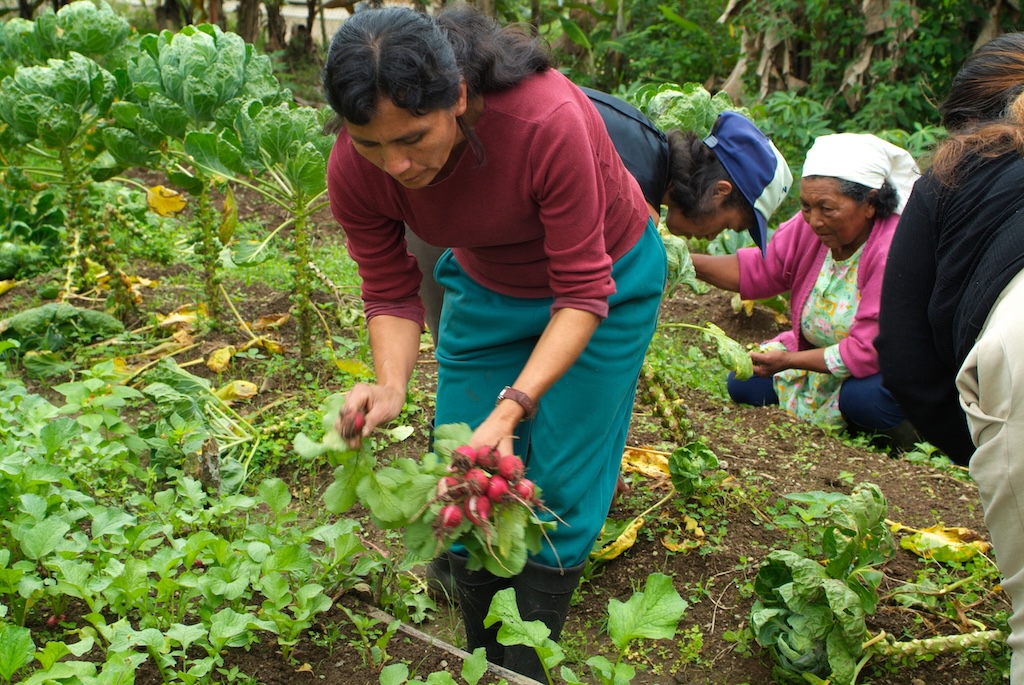
International Women’s Day occurs every year on 8 March. Carbon Brief explores the impacts of climate change and gender inequality on women farmers and how they are adapting to a warming planet.
Women farmers play an essential role in global food supply.
According to a report from the UN Food and Agriculture Organization (FAO), around 36% of working women in 2019 were engaged in agri-food systems. On average, they earned 18% less than men in that sector.
The report found that women working in agriculture tend to do so “under highly unfavourable conditions”, including in the face of “climate-induced weather shocks”.
Typically, women farmers are concentrated in the poorest countries, produce less-lucrative crops and are often unpaid family workers or casual workers in agriculture, the report said.
Vulnerabilities
Research has shown that women farmers are more vulnerable to the impacts of climate change than men.
In Africa and Asia, for example, a 2023 study found that “climate hazards and stressors…tend to negatively affect women [in agri-food systems] more than men”. This is because gender inequality – in the form of discriminatory gender roles or unequal access to resources – is most pronounced in those regions, the study said.
A 2025 study focusing specifically on the Sleman region of Indonesia found that 63% of women farmers suffered from food insecurity due to vulnerability to climate change. This arises from both frequent exposure to drought and low ability to respond to climate impacts, the study explained.
Geraldine García Uribe has been a farmer at the U Neek’ Lu’um agroecology school in Yucatán, Mexico, since 2023. She told Carbon Brief:
“When you have fixed [planting and harvesting] cycles and you start to see changes in the climate – longer droughts or changes in rainfall patterns – plants take longer to grow and pests start to arrive, and that affects the farmers’ pockets and the livelihoods of [their] families.”
She added that women farmers also face inequalities when it comes to deciding how to manage agricultural lands:
“When government support comes, they take [women] less into account because, in general, there are more men present at meetings.”
Adaptation needs
Women farmers face constraints that make them less able to adapt to climate change, according to the FAO report. For example, the working hours of women farmers “decline less than men’s during climate shocks such as heat stress”, said the report.
Josselyn Vega has been farming on her own agroecology farm in Cotopaxi, Ecuador, for three decades. In the Andean region comprising Ecuador, Bolivia and Peru, droughts and floods are frequent, but there are also frosts which, although expected to decrease with climate change, cause crop losses and can have a “drastic” impact on the local economy, according to the Adaptation Fund.
Vega told Carbon Brief that her farm has used “living barriers” to help protect from weather extremes:
“Living barriers are a wall of forest and fruit trees [that] block the wind and prevent drought and frost from passing through.”
The 2023 study recommended that transforming agri-food systems into fairer and more sustainable ones requires reducing and preventing gender inequality.
At the international level, countries have an agreement to implement climate solutions that take women into account, including women farmers. At the most recent UN climate negotiations in Belém, Brazil, countries adopted a new gender action plan, which will last nine years and encourages countries to develop climate policies and plans with a gender perspective.
Vega said that public policies are needed to empower women farmers and ensure that they are included in decision-making. She told Carbon Brief:
“We need to benefit from something that encourages us to continue planting and caring for the land.”
§ Watch, read, listen
CASH CUTS: In a four-part series, BioGraphic explored how US federal funding cuts have impacted biodiversity and conservation.
RIGHT WHALE ROLLBACK: A News Center Maine video looked at how the US National Oceanic and Atmospheric Administration is considering rolling back a rule to protect endangered North Atlantic right whales in the US.
ON THE FARM: “Women farmers are an overlooked force in climate action,” the deputy director of the climate office at the FAO wrote in Reuters.
JUSTICE: Drilled marked the 10-year anniversary of the murder of Indigenous leader Berta Cáceres and looked at why Honduras is “still so dangerous for environmental activists”.
§ New science
- Large-scale reforestation in different parts of the world could bring “robust net global cooling” of -0.13C to -0.25C | Communications Earth & Environment
- Insects in many parts of the tropics have a “limited capacity” to deal with future projected warming levels | Nature
- The flowering time of tropical plant species has changed by an average of two days per decade since 1794 due to climate change | PLOS One
§ In the diary
- 9-19 March: Part one of the 31st session of the International Seabed Authority | Kingston, Jamaica
- 15 March: Republic of the Congo presidential election
- 22 March: World Water Day
- 23-29 March: Convention on the Conservation of Migratory Species of Wild Animals COP15 summit | Campo Grande, Brazil
- 23 March-2 April: Third session of the preparatory commission for the High Seas Treaty | New York
Cropped is researched and written by Dr Giuliana Viglione, Aruna Chandrasekhar, Daisy Dunne, Orla Dwyer and Yanine Quiroz.
Please send tips and feedback to cropped@carbonbrief.org