Limiting global warming to 2C would not ‘rule out’ extreme impacts
Limiting warming to 2C above pre-industrial temperatures may not be enough to prevent “extreme global climate outcomes”, according to research published in Nature.
The authors simulate climate extremes – such as drought in breadbasket regions and flooding in populated areas – under a 2C warming scenario using a range of different global climate models.
They find that the “worst-case” model projections in a 2C warmer world are often more severe than the “average” scenarios in a 3C or 4C warmer world.
An author on the study tells Carbon Brief that, for policymakers planning around risk, it is “really important” to account for these potential extremes at 2C.
The findings are “sobering” and “demonstrate that the risks at 2C of global warming may be significantly higher than previously thought”, according to one scientist who was not involved in the study.
He adds that the methods used in the research would “offer a very useful contribution” to any future “global assessment of avoidable climate-change risks”.
§ High-risk scenarios
As the planet warms, climate extremes such as floods and droughts are becoming more intense and frequent. For policymakers to effectively plan and adapt to upcoming changes, they need to understand how severe these events could become.
Scientists routinely use global climate models to simulate how extremes may change over the coming decades. One well-established way to present these results is to run simulations using multiple models, then take the average of these results.
This average is known as the “multimodel mean”. Model results typically cluster around the mean, giving scientists more confidence in these results, but there are often also individual projections that sit notably higher or lower.
Prof Erich Fischer is a lecturer in environmental systems science at ETH Zurich and an author on the paper. He tells Carbon Brief that focusing on the multimodel mean is a “very valuable” communication tool for climate scientists, providing a “simpler” message than showing the full range of results.
For example, he tells Carbon Brief that the Intergovernmental Panel on Climate Change (IPCC) – the world’s most authoritative source on climate change – uses the multimodel mean to produce many of its maps.
However, Fischer warns that from a “risk perspective”, focusing solely on the multimodel mean could give a “misleading picture”. For example, he adds, the changes that specific regions may see could be “much, much higher” than the global average.
He tells Carbon Brief that for policymakers planning around risk, it is “really important” to account for more extreme cases too.
To demonstrate this, the study authors select 42 models from the Coupled Model Intercomparison Project 6 (CMIP6). These are the models that are used most widely in the latest set of IPCC reports.
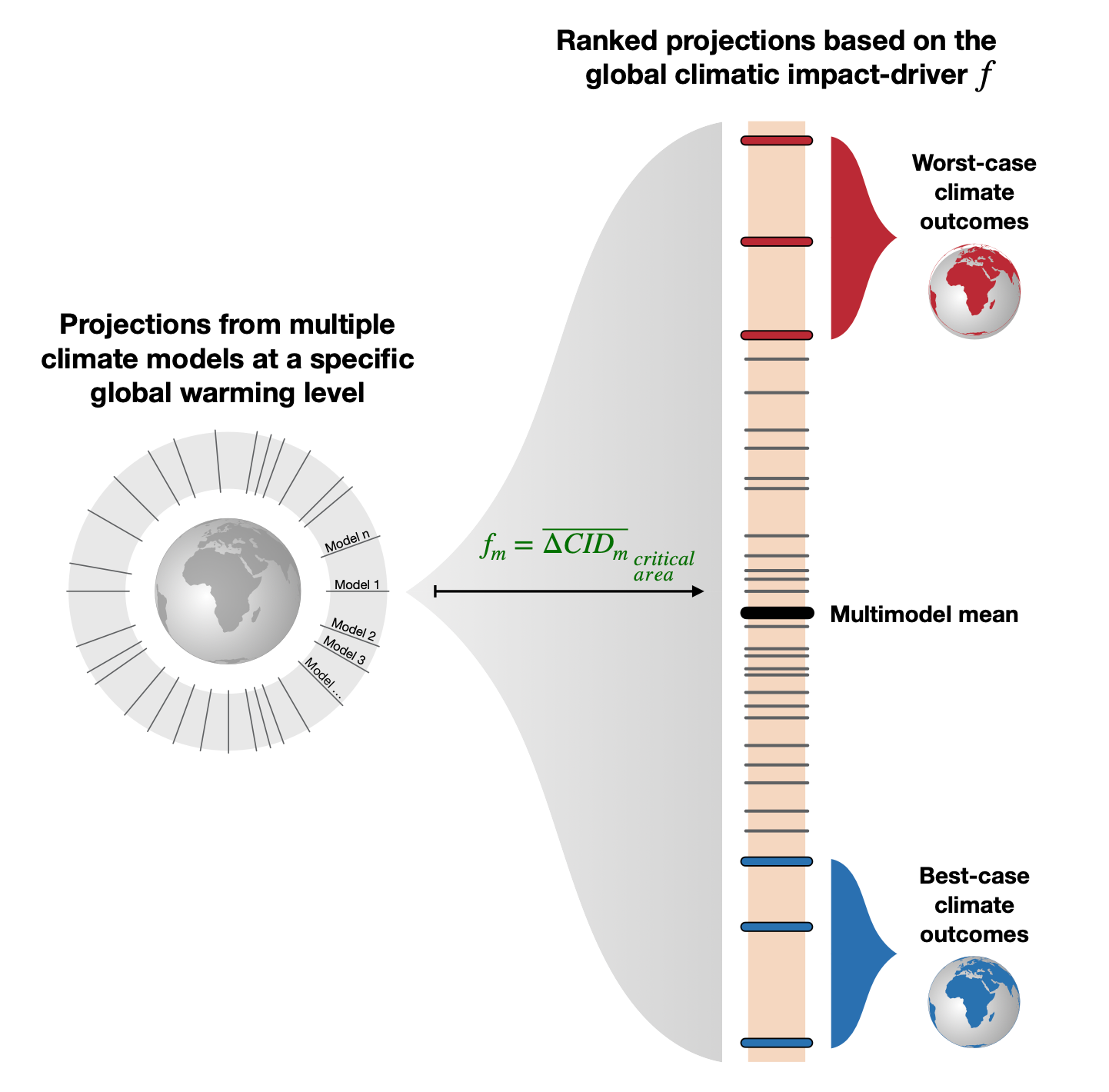
Their approach is illustrated in the diagram below. Note that this illustration is not based on real model runs, but is intended to give an example of what a set of results could look like.
The beige strip on the right shows the spread of results, where each horizontal bar indicates a different model. The models simulating the “worst-case” outcomes (red lines) are at the top and those showing the “best-case” climate outcomes (blue lines) are at the bottom. The majority of models are clustered towards the centre of the bar, close to the multimodel mean (thick black line).
The authors selected three types of events to analyse:
- Rainfall extremes in highly populated areas, which may induce flooding
- Concurrent droughts in global breadbaskets, which threaten food security
- Fire weather extremes across the world’s forests
For each event type, the authors assess the spread of results. They rank the model outputs by the severity of each type of event and compare these to the multimodel mean at different levels of warming – including 2C, 3C and 4C above pre-industrial temperatures.
In many instances, the “worst-case climate outcomes” in a 2C world are more severe than the multimodel mean in a 3C or 4C world.
Prof Rowan Sutton, director of the Met Office Hadley Centre, who was not involved in the study, tells Carbon Brief that the study’s findings are “sobering”. He adds that the paper “demonstrates that the risks at 2C of global warming may be significantly higher than previously thought”.
In its latest assessment report, the IPCC projected that, under current policies, the world could reach 2C of warming between 2037 and 2084, with a central estimate of 2052. (For more on when the IPCC says warming thresholds will be passed, read Carbon Brief’s explainer.)
§ Breadbasket drought
The analysis of drought in key breadbasket regions provided the “most striking results”, Dr Emanuele Bevacqua, a researcher at the Helmholtz Centre for Environmental Research and lead author of the study, tells Carbon Brief.
To assess the worst-case scenario, the authors simulated drought frequency in “critical breadbasket areas across the world”, he explains.
These are the regions where most of the world’s maize, wheat, soybean and rice is grown, including regions of northern and southern America, Europe, south-eastern Asia and Australia.
The spread of model results is shown below.
The vertical bars indicate the percentage change in average drought frequency between a pre-industrial and 2C warmer world, where more-frequent drought is at the top of the bar and less-frequent drought is at the bottom.
On the left bar, each horizontal line indicates one model. The models showing the “worst-case climate outcomes” are highlighted at the top of the bar. On the right bar, the horizontal bars show the multimodel means for warming levels of 2C, 2.5C, 3C and 4C.
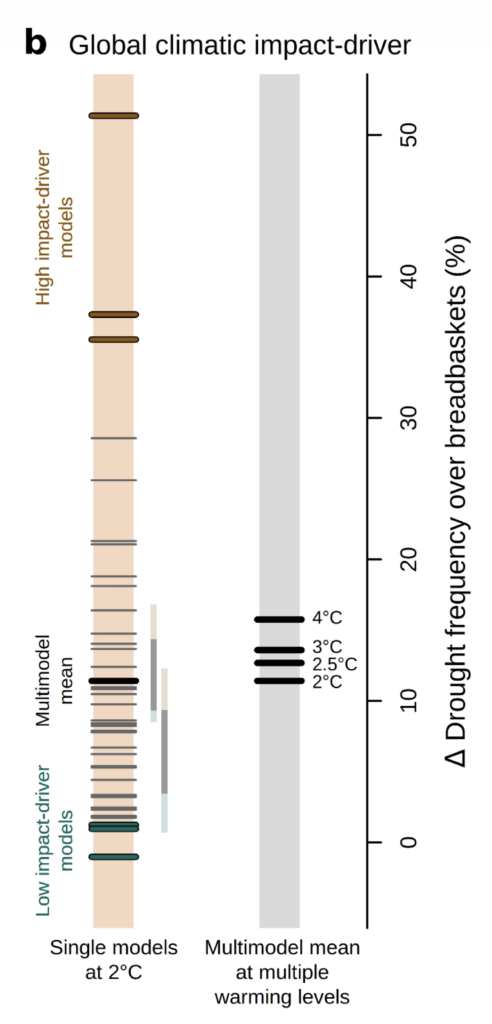
The percentage change in drought frequency in key breadbasket regions between a pre-industrial and 2C warmer world. On the beige bar (left), each horizontal line indicates a model. On the grey bar (right), the horizontal bars show the multimodel means for warming levels of 2C, 2.5C, 3C and 4C. Source: Bevacqua et al. (2026)
They find that 10 of the 42 models simulate a level of drought frequency at a 2C warming level that is higher than the multimodel mean at 4C warming.
(Some models also project a lower level of drought frequency at 2C warming than the multimodel mean. However, the focus of the study is to capture the most severe risks, which are particularly relevant for risk management.)
Bevacqua tells Carbon Brief that this result “makes it very clear that even if we stop [warming] at 2C, we cannot rule out the fact that we might end up in a worst-case outcome”.
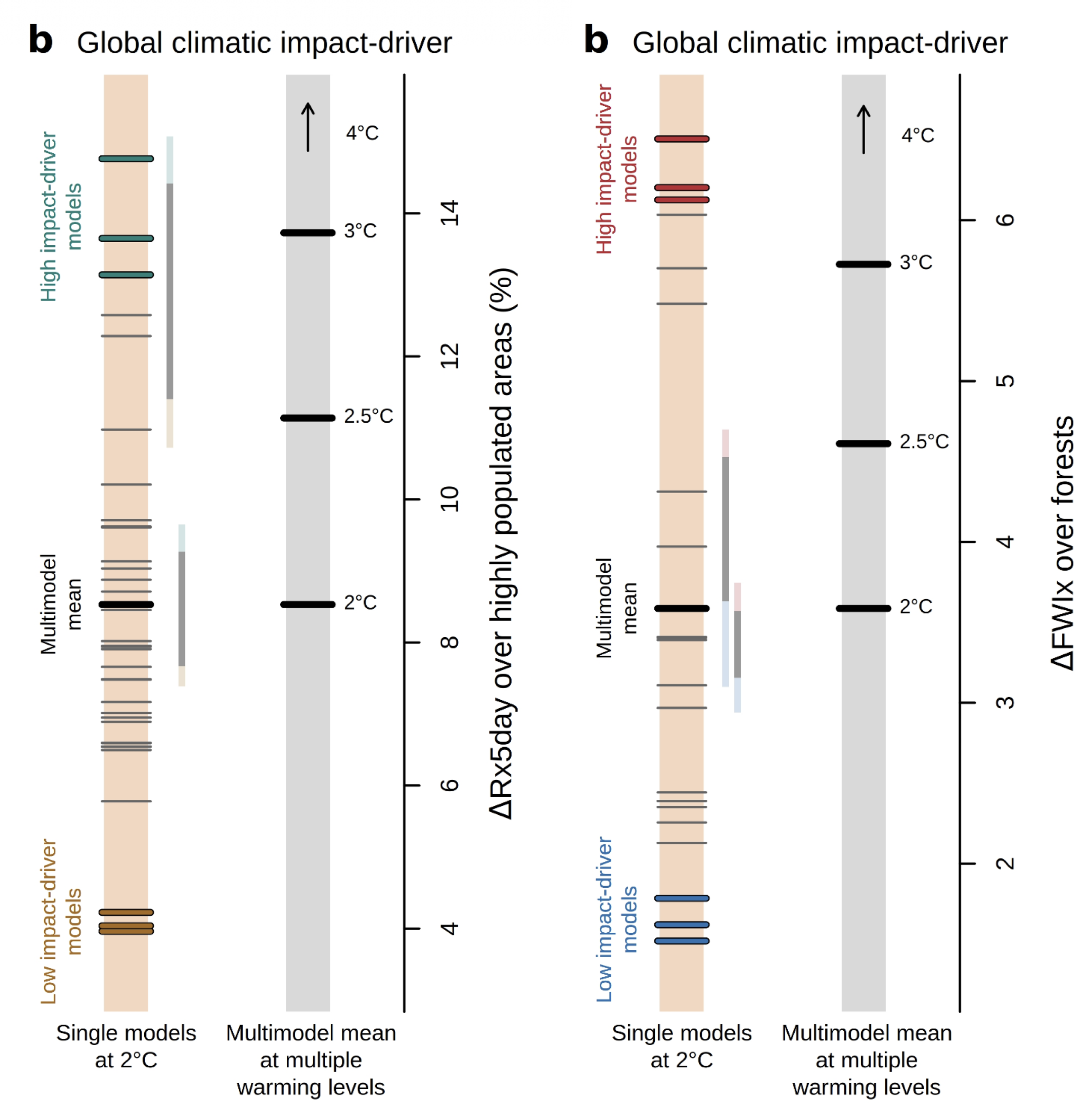
The authors also conduct their analysis for extreme rainfall in populated regions. Although they find a wide range of model results, none of the simulations of extreme rainfall at 2C are higher than the multimodal mean at 4C.
Meanwhile, analysing the risk of wildfires to the world’s forests reveals that four of the models simulate more severe fire risk at 2C than the multimodel mean at 3C and none simulate more severe fire risk at 2C than at 4C.
The spread of model results for rainfall (left) and wildfire (right) are shown below.
Dr Karen McKinnon is an associate professor in statistics and the environment at the University of California, Los Angeles. McKinnon, who was not involved in the study, tells Carbon Brief that the study highlights that “risks are obscured when considering averages across multiple climate models”.
§ ‘Worst-case scenarios’
The authors find that the ranking of models was different across the three case studies. In other words, the same models did not produce the “worst-case” climate outcomes in every type of event.
When assessing the impact of future extremes, the findings emphasise the need to select models that “sample the full range of possible climate outcomes”, the paper says. It adds:
“Currently, large-scale initiatives such as the latest protocol of the Inter-Sectoral Impact Model Intercomparison Project (ISIMIP) rely on a limited subset of climate models that likely omits the best- and worst-case climate models.”
ISIMIP is a global modelling effort to project the impacts of climate change across different sectors. Bevacqua notes:
“[O]ur results suggest that ISIMIP-based simulations probably underestimate the range of possible global impacts at a fixed global warming level of +2C.”
He adds:
“This is worrying and calls for new approaches that can somehow lead to accounting for this.”
The study also shows that many “best-case” model outcomes for a 2C world project a lower level of risk than the multimodel mean. However, Fischer notes that “even the best-case scenario” shows that extremes will become more severe with warming.
Fischer says that the study authors are not “doomscrolling” and notes that “landing somewhere in the middle is still the more likely outcome”. However, he emphasises the importance of considering the high-impact model outcomes for planning around risk.
§ Communicating risk
Climate scientists and policymakers have been discussing how best to assess and communicate climate risk for decades.
Dr Robert Vautard – senior climate scientist at France’s National Centre for Scientific Research at Institut Pierre-Simon Laplac, who was not involved in the study – tells Carbon Brief that the study provides “very insightful examples of outcomes for communicating risks”.
However, he questions whether the “global indices” used in this study would be relevant for developing “regional” adaptation plans, noting that worst-case impacts in the model “may not be the most problematic locally”.
Last month, a group of leading climate scientists published a comment article – also in Nature – calling for a global climate risk assessment that identifies the “worst-case scenarios” and helps societies to prepare for them.
The article says:
“Global assessments made by IPCC have played, and continue to play, a crucial part in assessing the evidence about climate change. But the IPCC produces science assessments, rather than risk assessments. Its main focus has been to set out what is known with the greatest confidence.
“A climate risk assessment offers different information – it makes clear the scale and severity of risks, to inform judgments about the priority to be given to avoiding or mitigating them.”
Sutton, the Hadley Centre director, is an author on the article. He tells Carbon Brief that “from a policy and decision-making perspective, climate change is a problem of risk assessment and risk management”.
He says that the methods used in this study “offer a very useful contribution to a global assessment of avoidable climate-change risks”.
Article information
Bevacqua, E. et al. (2026) Moderate global warming does not rule out extreme global climate outcomes, Nature, doi:10.1038/s41586-026-10237-9