China Briefing 2 April 2026: EV profits rise | Ming Yang rejected | Iran war
Welcome to Carbon Brief’s China Briefing.
China Briefing handpicks and explains the most important climate and energy stories from China over the past fortnight. Subscribe for free here.
§ Key developments
Climate on agenda at post-two sessions forums
‘UNWAVERING’ ON CLIMATE: “China will “unwaveringly” follow a low-carbon pathway, said environment vice-minister Li Gao at the China Development Forum (CDF) – a high-level and business-focused event traditionally held after China’s two sessions – according to business news outlet China Economic Times. Wang Jinsong, deputy director of the National Energy Administration, said China’s energy system will feature both “multi-energy” sources and “risk resilience”, reported industry news outlet BJX News. Liu Shijin, advisor at the China Council for International Cooperation on Environment and Development said China must develop “accountability mechanisms” and “quantitative” emissions reduction targets, said finance news outlet Sina Finance. CDF attendees included Chinese premier Li Qiang, Ministry of Ecology and Environment (MEE) head Huang Runqiu and National Development and Reform Commission chairman Zheng Shanjie, according to CDF organisers.
‘DEAL WITH IT’: Regarding international tensions over Chinese industrial exports, Bloomberg quoted Premier Li saying “we take our trading partners’ concerns seriously”, adding China has made “positive progress” in tackling the intense competition plaguing several industries, including clean-energy technologies. Nevertheless, consultancy Trivium China said in a note that the broad message at CDF was: “Yes, we’ve got an export-oriented growth model. Deal with it.”

IRAN IMPETUS: Meanwhile, Chinese climate envoy Liu Zhenmin attended the Bo’ao Forum for Asia in Hainan province, where he told Bloomberg that he “expects” the US will return to the Paris Agreement after the Trump administration. He added that the Middle East conflict will “definitely” not cause an oil or gas crisis in China, but had “convinced the government, at all levels, to speed up the energy transition”. (See Spotlight below.)
KOREA COOPERATION: The Bo’ao forum, a high-level platform for policymakers, business leaders and academics often compared to Davos, also featured a China-South Korea climate roundtable, where China Daily quoted former UN secretary-general Ban Ki-moon calling for climate solutions that “transcend borders”. A few days earlier, China and South Korea held their first climate dialogue in seven years, said the World Korea, where talks included this year’s COP31 climate talks in Turkey, renewable energy and carbon markets.
Sinopec says cleantech pushed down profits in 2025
PRE-IRAN SQUEEZE: All of China’s three-largest oil and gas companies saw profits fall in 2025, with Sinopec seeing a 36.8% decline last year due to “rising substitution by new energy” and “weak” margins, according to Reuters. PetroChina’s net profits fell 4.5% year-on-year, said Securities Times, despite an increase in production. CNOOC’s profits were down 11.5% year-on-year, said Reuters, largely due to low oil prices. (These figures predate the impact of the Iran war. Oil and gas firms have been enjoying windfall gains since the start of the conflict.)
EV PROFITS: Meanwhile, a “growing roster” of electric vehicle (EV) manufacturers are becoming profitable, reported industry outlet Inside EVs, with Leapmotor, Nio and XPeng announcing they have recently made profits for the first time. This has come partially at the expense of BYD, which saw its profits fall “for the first time in four years” due to price wars in China reaching a “fever pitch”, reported the Financial Times. A growing number of Chinese car dealerships are focused on EVs, said finance news outlet Yicai. Yicai also reported that dealerships around the world are seeing a “surge” in demand for Chinese EVs as the conflict in the Middle East raises petrol prices.
Ming Yang factory plans rejected
‘UNWISE DEPENDENCIES’: The UK government has rejected plans by Chinese wind turbine manufacturer Ming Yang to invest up to £1.5bn in a factory in Scotland, citing national security concerns, reported the Financial Times. In a statement to the UK parliament, energy minister Michael Shanks said the government “will always act to protect our national security” and is “committed” to developing “resilient and sustainable offshore wind supply chains”. Liam Byrne, chair of the parliamentary business and trade committee, said in a statement that the UK cannot “create…new and unwise dependencies”.
‘MISSED OPPORTUNITY’: In a response reposted by energy news outlet China Energy Net, Ming Yang said the government has “missed a critical opportunity” to partner with a company that has “no comparable [European] alternatives”. It said it had attempted to address security concerns through proposals such as only processing data onshore. An analysis in the Scotsman said that, while there were “genuine” concerns, “alignment with Japan and the EU on cybersecurity and energy” and US opposition drove the decision. The South China Morning Post cited an unnamed source saying the move was “likely” due to direct US pressure. On the same day, an investment by Danish turbine manufacturer Vestas was approved, reported BBC News, with Maf Smith, director of advisory firm Lumen and previously deputy chief executive of Renewable UK, asking on LinkedIn: “Coincidence?”
‘SKYROCKETING’ SOLAR: Elsewhere, Chinese solar exports to Cuba “skyrocketed” from $5m to $117m between 2023 and 2025 – even before the intensification of the US oil blockade, reported the Washington Post. China and the Philippines are “exploring” oil and gas cooperation in the disputed South China Sea following supply disruptions caused by the Middle East conflict, said Reuters. China has also “exported cargoes of diesel and other fuels” across south-east Asia, said Bloomberg, although Reuters said China would “extend its ban on refined fuel exports into April”.
More China news
- IPCC’S ‘LONGER TIMELINE’: Governments failed to agree if a key climate report should be published in 2028, ahead of COP33, with China among the countries arguing for a “longer timeline”, said Carbon Brief.
- SICHUAN SOJOURN: Premier Li toured several clean-energy sites in a visit to Sichuan province, urging officials to “continuously expand” capacity and “focus” on developing a “new-type power grid”, reported state news agency Xinhua.
- ENVIRONMENTAL CONSTRAINTS: The central government has said small hydropower projects must stay within the limits of what the local environment can tolerate, reported the Communist party-affiliated People’s Daily.
- MEE INVESTIGATES: In recent inspections, the MEE criticised several bodies, including steel, power and coal firms, on “reckless” development of ”dual-high” projects and poor execution of “their…low-carbon transitions”, said the People’s Daily.
- TRADE WAR POSITIONING: China has “launched a sweeping investigation” into US cleantech trade barriers, said Bloomberg.
- ENERGY EFFICIENCY: The Chinese government has published an action plan for high-quality “energy-saving equipment”, including a focus on hydrogen electrolysers and other power equipment, said Xinhua.
§ Captured
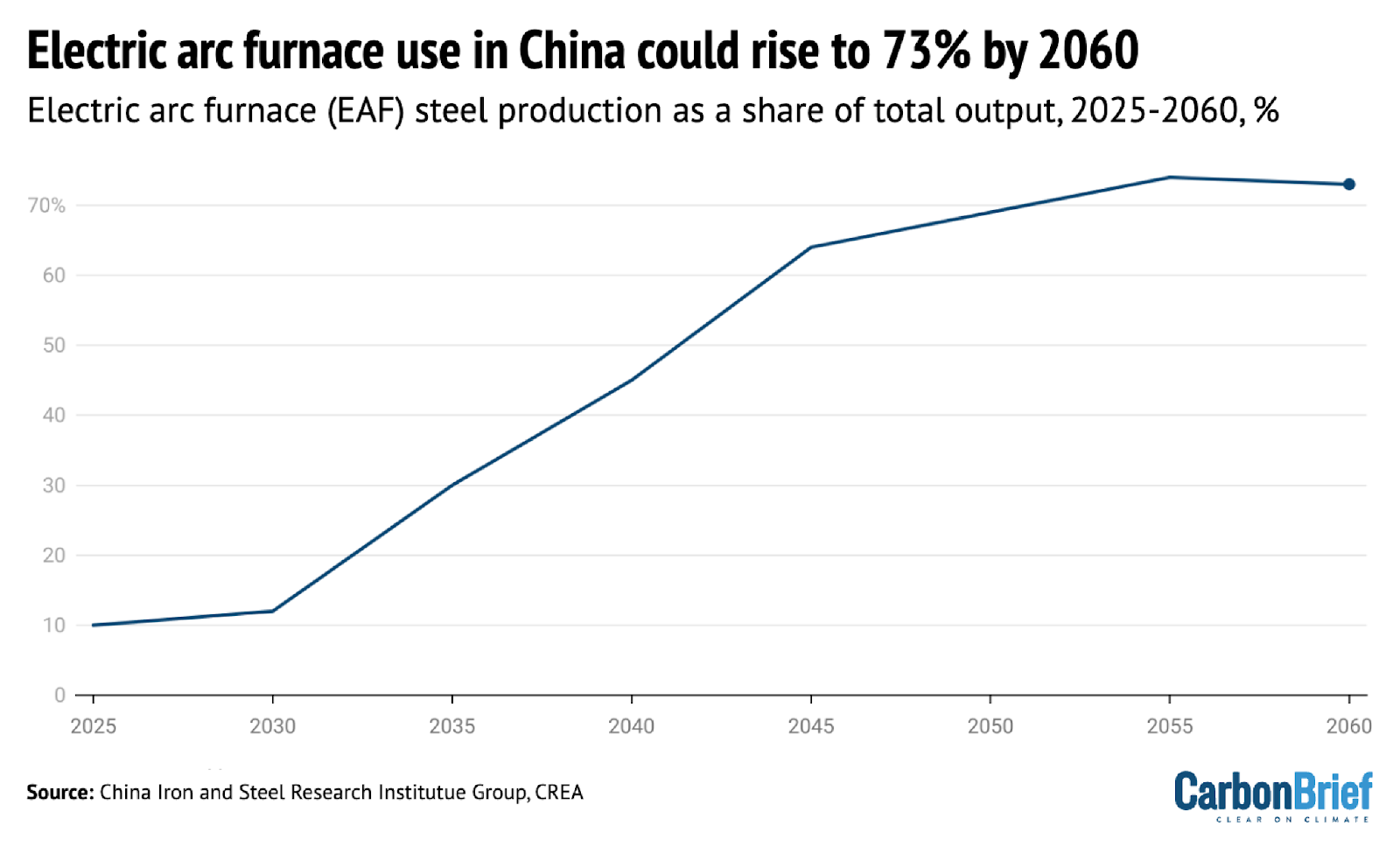
Steel produced by electric arc furnaces (EAFs), as opposed to burning coking coal, could account for at least 73% of China’s total steel production in 2060, according to a report by the Centre for Research on Energy and Clear Air (CREA). Under this scenario, EAF uptake could cause steel-sector emissions to fall to 1.3bn tonnes of carbon dioxide by 2035, “representing a nearly 37% reduction” from peak levels.
§ Spotlight
How Chinese media has been covering the Iran energy crisis
As the closure of the Strait of Hormuz wreaks havoc on fossil-fuel supplies across the world, a prominent narrative in western media has been that low-carbon energy has helped mitigate the worst of the impact on China. While Chinese-language media has featured similar arguments, it has also highlighted China’s coal industry and broader energy security narratives.
In this edition, Carbon Brief looks at how Chinese news outlets have covered the implications of the US and Israel war with Iran on energy use.
As the conflict intensified, several Chinese-language outlets put the spotlight on China’s clean-energy infrastructure.
The tensions highlight the “importance” of energy security and the energy transition, wrote Bo’ao forum secretary-general Zhang Jun in a commentary for the Communist party-affiliated People’s Daily.
The China Youth Daily, a party-run newspaper oriented towards younger readers, said the conflict has “exacerbated” fragile energy supply chains, underscoring the need to “develop new energy sources for energy security”.
Building “localised” clean-energy capacity is a “strategic necessity”, as well as an important aspect of climate action, wrote Wang Ning, associate researcher at the government-affiliated Institute of World Economy in the state-supporting Global Times.
Meanwhile, Liu Ying, research fellow at Renmin University’s Chongyang Institute for Financial Studies, told Xinhua that China is well-placed to benefit if the crisis catalyses a “restructuring of the global energy order” and hastens uptake of solar and wind power.
Echoing this sentiment, WeChat account Photovoltaic News, which is run by an unnamed individual, said: “New energy is precisely the core of China’s strength.”
Coal is king?
However, the broader commentary on the war has tended to emphasise China’s “all-of-the-above” approach to the energy transition.
A “sharp commentary” in the People’s Daily – a designation for comments that the newspaper finds important – said that a range of initiatives, from “diversified energy imports” to “vigorous development of green energy” allowed China to “secure its energy supply” and “take the initiative in energy security”.
Similarly, an editorial in commercial news outlet 21st Century Business Herald said that China is “less likely to face direct impacts from this oil crisis” because of its reliance on both coal and renewables.
It also noted the opportunity that the conflict represented in terms of greater global demand for Chinese clean-energy technology.
Coal’s role in the energy mix as a “ballast” and “peak-shaving” tool “continues to strengthen”, said economic news outlet Jiemian – although the outlet also acknowledged China’s “vigorous” clean-energy additions.
Pro-coal accounts on WeChat especially emphasised the fuel’s role in the crisis.
Coal will “continue to serve as the cornerstone of energy supply”, said Coal Vision, a WeChat account run by Xiamen Zhengzhuo Trading, a firm that trades coal and other commodities.
Similarly, Guizhou Coal Data argued: “When a real emergency strikes, you have to ask: which energy source do we truly control? There’s only one answer: coal.” The account is run by the information services firm Guizhou Yuteng Coal Industry Big Data Information Center.
Several outlets also highlighted China’s efforts to secure gas supplies from elsewhere.
Wen Shaoqing, columnist at nationalist outlet Guancha, wrote that an agreement between China and Turkmenistan shortly after the conflict began that reaffirmed plans to develop a new gas pipeline represented a “strategic” move to secure the “nation’s survival”.
Notably, two articles in Guancha summarising foreign outlets’ coverage of China’s response – both emphasising the role renewable energy played in insulating China from the energy shock – also received more than 100,000 views.
Security in coal chemicals
Meanwhile, Xinhua published an article on “turning China’s advantage in coal resources into an advantage in developing natural gas”, although it did not explicitly mention Iran. It added that the head of China’s state-owned PetroChina Coalbed Methane Co argued that coalbed methane could “propel China from [being] an energy giant to an energy powerhouse”.
Shortly after the Xinhua article was published, Jiemian said China had a responsibility to develop coalbed methane to “secure our energy self-sufficiency”.
Similarly, several news outlets covered the “boon” that the war might be for China’s coal-chemical industry.
An article posted by WeChat account Xinghai Intelligence Bureau argued that China’s development of a coal-chemical industry, rather than “new energy”, is what prepared it for “worst-case scenarios” such as the war. The account is run by technology media company Beijing Lightspeed Time Network Technology.
Finance news outlet EastMoney said that the “strategic value” of China’s coal-chemical industry will likely rise “against the backdrop of growing global instability”.
§ Watch, read, listen
RURAL SOLAR: New Security Beat published an on-the-ground look at how a rooftop solar push is playing out in a rural village in China.
TARGET TESTED: 21st Century Business Herald examined China’s new 17% carbon-intensity target, noting that projects already underway will take up a “significant portion of the carbon-emission growth allowance for the five-year plan”.
ELECTRON PIVOT: Redefining Energy spoke to the Oxford Institute for Energy Studies’ Dr Michal Meidan on the factors driving China’s energy transition.
GEOTHERMAL LIMITS: ChinaTalk outlined the evolution of China’s approach to geothermal energy and the constraints that have limited uptake.
§ 470%
How much Chinese solar exports to the Middle East grew year-on-year in the first quarter of 2026, according to WeChat news account Photovoltaic Box.
§ New science
- “International climate policy actors” play an “overlooked yet critical” role in fostering climate policy “stability” in China through their links with policymakers | Environmental Politics
- Climate change will degrade peatlands in Sichuan province over the coming century, driving biodiversity shifts and a decline in species richness | Frontiers in Plant Science
§ Recently published on WeChat
China Briefing is written by Anika Patel and edited by Simon Evans. Please send tips and feedback to china@carbonbrief.org