Cropped 6 May 2026: Forest loss falls | Deforestation regulations | Saving ‘India’s Galapagos’
We handpick and explain the most important stories at the intersection of climate, land, food and nature over the past fortnight.
This is an online version of Carbon Brief’s fortnightly Cropped email newsletter.
Subscribe for free here.
§ Key developments
Forest loss falls
DRIVER DECLINE: Tropical primary forest loss fell by more than one-third from 2024-25, according to the latest edition of the Global Forest Review. (Primary forests are those that are intact or relatively undisturbed by humans.) The World Resources Institute, which co-produced the report, noted that the loss of these forests is “still 46% higher than [it was] a decade ago”. It attributed much of this year’s decline to a decrease from last year’s “record-breaking year of extreme fires”.
WIDESPREAD COLLABS: Although Brazil had the largest loss in terms of area, deforestation in the country fell by 42% compared to the previous year, reported Agência Brasil. It noted that this was made possible by a governmental task force, “with the participation of civil society, academia, local communities and the private sector”. In Indonesia, Malaysia and Colombia, progress “reflected improved governance, recognition of Indigenous land rights and corporate commitments to deforestation-free production”, said EnviroNews Nigeria.
EXCEEDING THE LIMIT: Despite the decline, the amount of deforestation “still remains ‘far above’ the level required to put the world on track to meet international targets to halt and reverse forest loss by 2030”, said BusinessGreen. It added that “fires present a growing threat that could reverse recent gains”, despite the declines from 2024. Reuters noted: “Agricultural expansion continued to be the biggest driver of forest loss around the world.”
EU deforestation law watered down
UNDER PRESSURE: Following industry pressure, the European Commission decided to “exclude imports of leather from its anti-deforestation law”, according to Reuters. The newswire said: “Leather industry groups have argued that as a by-product of the meat industry, with a relatively low value, leather’s production does not incentivise the cattle farming that drives deforestation.” It added that imported beef is still covered by the law.
‘LONG-OVERDUE’: Meanwhile, a group of UK Parliament members released an open letter calling for “long-overdue regulations to end UK imports linked to illegal deforestation”. Although the forest-risk regulation was introduced in 2021 as part of the Environment Act, “lawmakers have spent the last four years delaying the implementation” of the anti-deforestation rules, according to a Mongabay report from last year.
PROVISIONAL DEAL: The EU-Mercosur deal – a trade agreement between the European bloc and four South American countries – provisionally came into force on 1 May “after 25 years of negotiations”, said Euractiv. The application of the agreement is provisional because members of the European Parliament “referred the deal to the European Court of Justice for a legal review” in January, it added.
§ News and views
- PACKAGING PLANTATION: Asia Symbol, a China-based pulp and paper company, cleared “vast tracts of Indonesian rainforest home to endangered orangutans…for plantations supplying a maker of ‘carbon-neutral’ packaging”, according to an investigation by Agence France-Presse and the Gecko Project. The company told AFP that it is “committed to its no-deforestation policy”, while the newswire noted that the plantations supplying the paper mill have permits from the Indonesian government.
- SODA MOUNTAIN SOLAR: The California Energy Commission approved a proposed $700m solar power plant in the Mojave Desert after “nearly 20 years” of challenges, reported the San Bernardino Sun. Last month, climate journalist Sammy Roth dove into the history of – and current debate over – the Soda Mountain project on his Substack, Climate Colored Goggles.
- POSITIVE TIPPING POINTS: In a Nature Sustainability perspective piece, Prof Tim Lenton at the University of Exeter argued for the existence of “positive tipping points” – ecological, social or socio-ecological states where feedback loops that “suppor[t] self-propelling nature-positive change can help” achieve nature-recovery goals.
- ‘ACUTE HUNGER’: Nearly eight million people in South Sudan are at risk of “acute food insecurity” in coming months, “fuelled by ethnic conflict, climate change and the spillover of fighting from neighbouring Sudan”, according to Al Jazeera coverage of a new Integrated Food Security Phase Classification analysis. Meanwhile, a UN-produced global food crises report showed that “acute hunger” has doubled over the past decade, with two famines declared last year for the first time since the reports began a decade ago.
- SUMMERTIME SADNESS: Production of India’s prized Devgad Alphonso mango “has dropped by 70-90%” this summer, due to both “climate shock” and “ineffective pesticides”, reported the Print. Rich mango farmers in western India staged a “rare protest” demanding compensation for their losses, the outlet added, while a Print comment called for a “shift from compensation to climate-adaptation policies”.
- SEED SUIT: A judge at the Kenyan High Court “declared unconstitutional parts of a law that prohibited farmers from sharing and selling Indigenous seeds” – although the government has appealed the decision, reported Devex. The lawyer who represented the farmers in the suit “said that the ruling could have ripple effects worldwide”, it added.
§ Spotlight
Saving ‘India’s Galapagos’
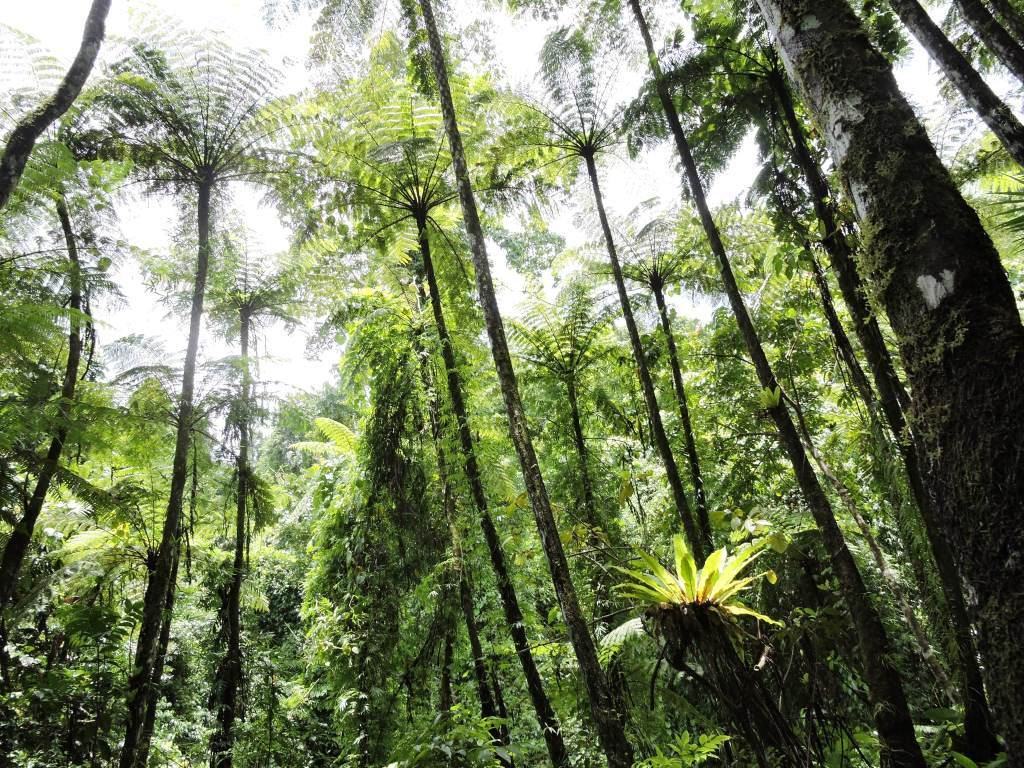
This week, Carbon Brief follows the uproar around the Great Nicobar project, after India’s opposition leader visited the biodiversity hotspot, which is at imminent risk of deforestation.
On 30 April, Rahul Gandhi – the head of India’s opposition and grandson of former prime minister Indira Gandhi – posted an Instagram video from the evergreen rainforest on Great Nicobar island, the southernmost point of India’s territory.
The island is the site of a proposed $10bn infrastructure project called the Great Nicobar Island Project, which includes a transhipment port in Galathea Bay, an international airport, a township and a gas and solar-based power plant.
Completion of the project would require the felling of more than a million trees – nearly 130 square kilometres of forest.
Speaking to the camera and dwarfed by gigantic tree trunks, Gandhi said:
“I’m in the middle of what is easily the most beautiful forest I’ve seen in my life.”
As drone footage showed viewers the lush forest canopy, Gandhi told viewers that the primary forest here is so dense, there was simply no way through. He continued by claiming:
“Now I understand why the government did not want me to come…because this is the largest theft of Indian ecological property in history.”
(In February, India’s National Green Tribunal upheld environmental clearances for the project, stating that the government had “considered all possible damage to the ecology and had taken efforts to compensate it”, according to the Hindu. A challenge is pending in the Calcutta High Court. In March, India announced it was raising its forest carbon target in its 2035 climate pledge.)
The provocative video calling for a halt to large-scale deforestation on “India’s Galapagos” has garnered more than 1.4m views and has sparked media debate, smear campaigns and government pushback, defending its strategic importance.
Paradise almost lost?
Barely hours after Gandhi’s video was posted, the Indian government published a press release detailing how environmental and tribal welfare safeguards have been met, despite more evidence to the contrary emerging this week.
Several media outlets – particularly print and independent outlets – have gone to Great Nicobar since 2024 to investigate the project’s impacts on biodiversity, assess its economic viability and corroborate the government’s claims of receiving Indigenous consent.
However, many of the project’s details have been shrouded in secrecy and restrictive conditions, including “gag orders” on scientists, rebuffed right to information requests and missing maps of tribal lands and coral colonies, media investigations have alleged.
For many mainland Indians, Gandhi’s video was a first glimpse of the Great Nicobar Biosphere Reserve and its 1,800 species, many of them endemic to the islands.
Turtle walker
Among the most charismatic and vulnerable are Great Nicobar’s sea turtles: leatherbacks, hawksbills and Olive Ridleys.
In an era before Instagram, biologist Satish Bhaskar surveyed over 4,000km of India’s coastline on foot from 1977-96 to document sea turtle nesting sites. Bhaskar laid the groundwork – and established the baseline – for Great Nicobar’s biodiversity and turtle conservation in India.
With only a transistor radio for company, Bhaskar would “maroon himself” on these islands for months at a time to measure tracks in the sand, count eggs and nests and wait for sightings of leatherback sea turtles, which can grow up to 2.7 metres long and weigh up to half a tonne.
From 1991-92, Bhaskar recorded more than 800 leatherback turtle nests on Great Nicobar Island alone. He identified Port Campbell Bay – where Gandhi met Nicobarese leaders last week – as a critical, irreplaceable turtle-nesting beach during his surveys.
“I’m glad I did what I did,” said the soft-spoken biologist in the 2025 documentary Turtle Walker, which recreates his early years on the island. However, this new footage of Nicobar’s coastal reefs, mangroves and evergreen forests – is still only accessible to film festival audiences in India.
Can more visual, vocal and felt evidence shift the debate on deforestation in India? Experts told Carbon Brief that remains to be seen, but Gandhi’s video has brought “tremendous attention” back to the project, and brought in unlikely allies examining its impacts.
§ Watch, read, listen
GO FISH: BBC News explored how climate change is “threaten[ing] the economic backbone” of the Pacific island nation of Kiribati – its tuna fisheries.
LIFE AFTER COWS: The New York Times profiled Butter Ridge’s dairy farmers selling their generations-old Pennsylvania farm in the face of looming tariffs and “surging” input costs.
C FOR COMMODITY: On the Wilder podcast, Sue Pritchard – chief executive of the Food, Farming and Countryside Commission – explored the “invisible forces” shaping modern food systems.
WAR FALLOUT: From oil spills to contaminated soil, Wired took a closer look at how the war on Iran is impacting the environment in “unseen ways”.
§ New science
- Commercial bottom-trawling fishing costs Europe nearly €16bn per year, mainly due to the release of carbon from ocean sediments | Ocean & Coastal Management
- A combination of global warming of 1.5-1.9C and deforestation of 22-28% could drive the Amazon to “system-wide changes” | Nature
- By 2050, 74% of the current habitats of all land mammals, birds, reptiles and amphibians could be exposed to heatwaves under a high-emissions scenario | Nature Ecology & Evolution
§ In the diary
- 11-15 May: 21st session of the UN Forum on Forests | New York City
- 11 to 15 May: Food and Agricultural Organization (FAO) regional conference for Europe | Dushanbe, Tajikistan
- 13 May: Webinar on the State of Forests report from the World Resources Institute | Online
- 22 May: International day for biological diversity
Cropped is researched and written by Dr Giuliana Viglione, Aruna Chandrasekhar, Daisy Dunne and Orla Dwyer. Please send tips and feedback to cropped@carbonbrief.org