Cropped 20 May 2026: Deforestation roadmap | Melanesian Ocean Summit | Returning pet parrots to the wild
We handpick and explain the most important stories at the intersection of climate, land, food and nature over the past fortnight.
This is an online version of Carbon Brief’s fortnightly Cropped email newsletter.
Subscribe for free here.
§ Key developments
Deforestation talks
COP30 ROADMAP: Brazil’s global roadmap away from deforestation will involve countries producing their own voluntary pathways to halt and reverse forest loss by 2030, according to a first outline covered by Climate Home News. At the COP30 climate talks in Belém last year, some 93 countries called for a deforestation “roadmap” to be part of the summit’s formal outcomes. Despite this, countries failed to agree to one – leading host nation Brazil to promise to bring forward a voluntary roadmap as a compromise.
FOREST FORUM: Speaking at the UN Forum on Forests earlier this month, Juliano Assunção, an advisor to the COP30 presidency on deforestation, presented a first outline of the roadmap, said Climate Home News. According to the publication, Assunção said the roadmap “will not prescribe a single model”, but would instead invite countries to convert their pledges “into forest roadmaps grounded on regional and national diagnosis”. Elsewhere at the forum, Indonesia announced carbon-offsetting plans involving the restoration of 12m hectares of degraded land, said Reuters.
GOALS REPORT: Amid the talks, the UN published its latest assessment on achieving six global forest goals for 2017-30, concluding that “progress is evident, but insufficient”. Down to Earth reported that, according to the report, the world remains off track on two of the “key” targets: ending deforestation and eliminating extreme poverty among forest-dependent populations. Sustainability magazine reported that the goals set a target of increasing global forest area by 3% by 2030, but that, in reality, forest area has declined by more than 40m hectares since 2015.
Melanesian Ocean Summit
SEA SOLIDARITY: The leaders of Papua New Guinea, Fiji and Vanuatu signed a declaration to establish the Melanesian Ocean Corridor of Reserves, reported the Pacific Islands News Association. The corridor will “establish joint border governance, enforcement and marine science frameworks” across five Pacific nations and territories, said the outlet. Vanuatu’s prime minister, Jotham Napat, told the Melanesian Ocean Summit that the corridor “reminds us that our solidarity, not the legacy of colonial rule, determines our future”, according to Vanuatu’s Daily Post.
SEA SOVEREIGNTY: Part of the Melanesian corridor is a new marine protected area the size of the UK, announced by Papua New Guinea at the summit, said Oceanographic magazine. The new MPA will “prohibit all fishing within its boundaries”, reported the outlet. Meanwhile, Tuvalu’s Post Courier reported that the country is “currently developing its first-ever national-security policy, which will place maritime conservation and management at the absolute centre of the country’s strategic architecture”. Prime minister Feleti Teo stated: “The ocean is our sovereignty.”
CONSIDER THE OCEAN: In a comment article in the journal npj Ocean Sustainability, Dr Carlos García-Soto from the Spanish National Research Council wrote that there is a “structural weakness” in UN climate processes. He noted that the final decision text from COP30 “omitted the ocean entirely”, despite the summit “deliver[ing] the strongest ocean-related initiatives ever presented at a UN climate conference”. García-Soto also outlined five key priorities for integrating ocean considerations into climate governance.
§ News and views
- CANADA OWN GOAL: The Canadian government has no plans to enshrine into law commitments meant to ensure the nation meets its international nature goals, despite hosting the pivotal COP15 biodiversity summit less than four years ago, said CBC News.
- CREDIT CHANGE: Brazil’s national monetary council has postponed a regulation that would have blocked farms involved in deforestation from receiving rural credits, reported Folha de São Paulo. The change occurs “following pressure from agribusiness groups to relax the rules”, said the outlet, and means the requirement will now not take effect until January 2027.
- SAND CRISIS: A growing global appetite for sand is outstripping demand and threatening ecosystems, according to a new UN report covered by Reuters.
- LAOS DAMMED: A natural world heritage site in northern Laos is being put at risk by a $3.5bn dam project, reported Nikkei Asia.
- RAPID RESPONSE: The European Commission released its fertiliser action plan to “provide rapid support to farmers…and prevent rising food prices” amid the conflict in the Middle East, said Agenzia Nova.
- MARSH REVIVAL: Rising water levels are “beginning to revive” southern Iraq’s Cibayish marshes following a years-long drought and “drawing buffalo herders and fishermen back to areas once abandoned”, said Reuters. The country’s water ministry was able to “release growing volumes” of water from reservoirs following heavy winter rains, added the newswire.
§ Spotlight
Returning pet parrots to the wild
This week, Carbon Brief visits a conservation project working to return former pet parrots to the wild in Colombia.
Beautiful feathers. The playfulness and intellect of a small child. On occasion, the ability to partake in some pleasant conversation.
Parrots have captured the attention of humans for centuries. But their unique qualities have also contributed to their decline in the wild.
Some 16m parrots were moved across borders to be sold as pets over 1975-2016, according to one study, making them the most internationally traded bird in the world.
In Colombia, the world’s most biodiverse country by area, the introduction of tougher laws in 2016 means keeping a wild animal as a pet is now viewed as a “crime against the environment”, punishable with monetary fines.
These stricter rules led to greater numbers of wild parrots being seized by the police and more people giving up their birds voluntarily.
But this clampdown created a new conundrum: What will the Colombian authorities do with their growing population of these, formerly pet, parrots?
A charity called Fundación Loros – “Parrot Foundation” in English – hopes to have the answer.
Parrot rehabilitation
The foundation is based on 33 hectares of tropical dry forest in Bolívar – around a 40-minute car ride from the popular tourist city of Cartagena on Colombia’s Caribbean coast.
The deafening screeches of parrots when entering through the site’s gates were impossible to ignore.
Inside, foundation guide Corina walked Carbon Brief through the various stages of pet parrot rehabilitation.
Former pet parrots that are released directly into the wild are unlikely to survive. This is because they often lack the necessary skills, such as how to find food or stay away from predators, including monkeys and coatis.
Parrots arriving at the foundation follow a seven-stage process.
First, they are checked over by a vet and given a tag, so they can be continuously monitored.
Following this, they are kept in a large enclosure and slowly reintroduced to the types of food they might encounter in the wild, including wild fruits and nuts.
After this, they undergo “flight training” – many of the parrots will have been kept in a small cage and never learned how to travel long distances. This involves workers encouraging the birds to fly greater distances in exchange for rewards.
They also join other birds for “flock cohesion” lessons. In the wild, parrots are highly social animals who rely on their group to survive and raise chicks.
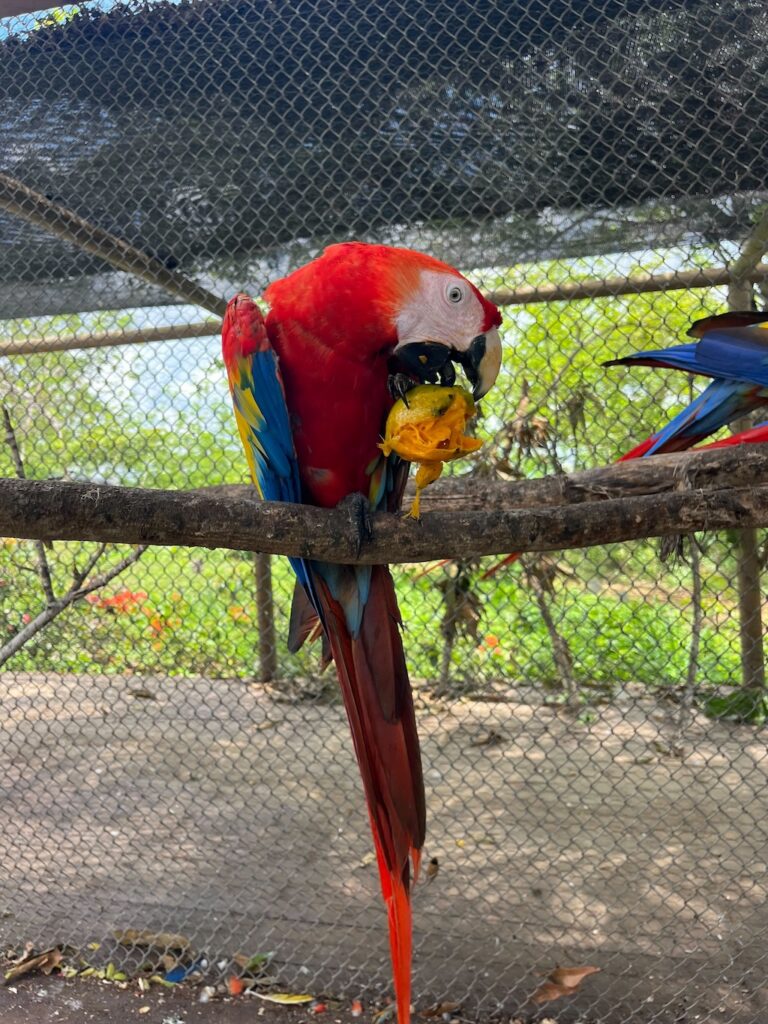
Following these steps, parrots are taken deeper into the foundation’s forest reserve – away from loggers and poachers.
There, they spend some time in an enclosure getting acquainted with their new surroundings.
After this, the door to the cage is opened – allowing them to fly free, but return for shelter and food if they need. Eventually, the birds settle back into the wild.
Waiting list
In addition to their parrot rehabilitation programme, the charity built a series of nest boxes and installed them high in the tree canopy across the reserve.
Their continuous monitoring of the birds has shown that many of the former pets have started raising wild chicks.
The work is hugely rewarding, said Corina, but the charity currently has a waiting list that is “months long”, given the growing number of wild animals needing rehabilitation across Colombia.
Despite helping the authorities with their wild animal problem, the charity largely relies on private donations to continue, she said. The hope is to develop an eco-tourism model to make more revenue in the future, she added.
§ Watch, read, listen
CARBON CONSULTATIONS: The Diplomat explored whether local residents were properly consulted on a carbon-offsetting programme in Cambodia.
FISH FIGHTS: The Ghanaian Times examined the tensions surrounding marine conservation in the country and how it is unduly burdening small-scale fisherfolk.
DELTA WORK: Mongabay reported on how the world’s “great deltas” are sinking, leading to the loss of a “global food system”.
LITHUANIA PEAT BOGS: The New York Times reported on Lithuanian efforts to restore peat bogs in order to “reinforce the border” and “lock away” carbon.
§ New science
- Coastal marshes are encroaching on uplands “nearly twice as fast” on agricultural land as they are on forestland, suggesting that agricultural practices are “accelerat[ing] the impacts of saltwater intrusion” | Nature Sustainability
- Fungi that cause diseases in plants will approximately double in abundance around the Antarctic Peninsula by 2100 under a moderate emissions scenario | Global Change Biology
- Conserving Ethiopia’s protected areas currently involves managing “trade-offs between nature and people” that are “central to whether global biodiversity commitments can be delivered” | Nature Ecology and Evolution
§ In the diary
- 20-22 May: Informal consultations of parties to the UN Fish Stocks Agreement | New York City
- 30 May-6 June: Meeting of the Global Environment Facility Assembly | Samarkand, Uzbekistan
- 31 May: Colombian presidential elections
- 8-18 June:Subsidiary body meetings of the UNFCCC | Bonn, Germany
Cropped is researched and written by Dr Giuliana Viglione, Aruna Chandrasekhar, Daisy Dunne and Orla Dwyer. Please send tips and feedback to cropped@carbonbrief.org