Analysis: 84% of nations miss deadline to identify ‘nature-harming’ subsidies by 2025
Most countries failed to meet a 2025 target to identify all of their subsidies that could be “harmful” to biodiversity, according to Carbon Brief analysis.
The findings also reveal that 32 countries spend an estimated $270bn on biodiversity-harming subsidies and other incentives each year.
This is the “tip of the iceberg”, one expert notes, with “trillions” spent globally.
In 2022, almost every country in the world agreed on a set of “goals” and “targets” aiming to halt and reverse biodiversity loss by 2030.
One of these targets asked countries to identify all subsidies that damage biodiversity by 2025, before phasing out or reforming at least $500bn of these incentives by 2030.
The subsidies can be found in a range of sectors, including fossil fuels, agriculture, forestry, mining and fishing.
Just 21 countries appear to have met the 2025 goal, Carbon Brief finds, based on analysis of 134 national reports submitted to the UN Convention on Biological Diversity (CBD) by 1 July 2026.
Five of the world’s 17 megadiverse countries were among those that met the deadline.
Country progress
Carbon Brief’s analysis looks at the number of countries that have met the 2025 target to identify their use of nature-harming subsidies.
However, the metrics to determine which countries have “met” this target are not explicitly defined.
Carbon Brief included any country that says it has completed the process of identifying its subsidies. In almost every case, these countries also included a total figure for the value of those subsidies.
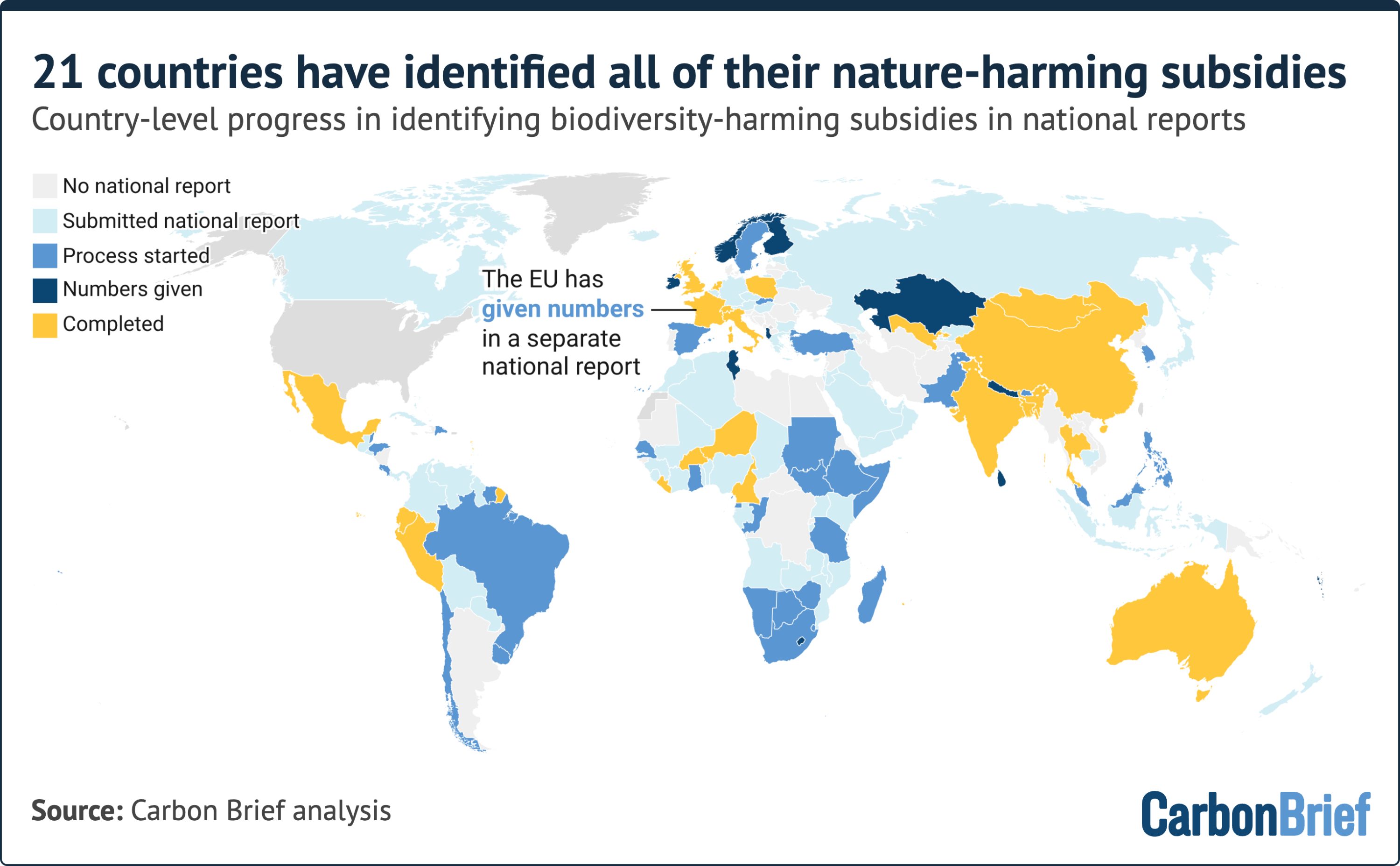
The analysis finds that 21 countries say they have identified their harmful subsidies, as shown in the map below (yellow). This amounts to 16% of the countries that have submitted national reports so far.
A further 11 countries, plus the EU, have provided figures for some of their subsidies, such as only those in a specific sector (dark blue).
Of the 134 national reports submitted to the CBD, 66 make reference to beginning the process (medium blue), while the remaining 68 do not (light blue). The final 62 countries party to the CBD have yet to submit a national report (light grey).
(Every country in the world participates in the CBD, except for the US and the Holy See – the governing body of the Catholic church, which is seated in Vatican City.)
The 32 countries that have identified some or all subsidies spend almost $270bn on nature-harming incentives annually, according to Carbon Brief’s analysis.
This is based on a tally of the figures for the most recent available year listed in countries’ national reports, in US dollars using conversion rates at the end of the given year and adjusted for inflation. The analysis also includes figures from other reports cited in the country submissions.
The $270bn reported in country submissions to date is “just the tip of the iceberg”, notes Eva Zabey, the chief executive of Business for Nature. The global figure could be as high as $1.8tn, according to a 2022 estimate from non-profit group, the B Team.
The figures identified by Carbon Brief are a “warning” that the “world is not moving fast enough” to tackle harmful subsidies, Zabey says, adding:
“The positive news is that some countries have shown it can be done and this should embolden others to follow suit…Subsidy reform should be treated as an economic necessity, not an environmental checklist.”
Harmful subsidies are expected to be among the key priorities at the upcoming COP17 UN nature summit, being held in Armenia in October 2026.
Subsidy target
There is no single definition of a “harmful” subsidy. (See: ‘Harmful’ subsidies.)
The aim to identify these subsidies stems from target 18 of the Kunming-Montreal Global Biodiversity Framework (GBF) – the global agreement containing a series of goals and targets for nature.

Target 18 calls on countries to identify subsidies and other incentives that are harmful for biodiversity by 2025.
It also says that nations should “eliminate, phase out or reform” these subsidies in a “proportionate” way, reducing them by at least $500bn per year by 2030.
It says countries should first target the “most harmful” incentives, while simultaneously scaling up positive incentives for nature.
All 2030 targets in the GBF are global – with countries each expected to outline how they will contribute nationally. So far, 169 countries have submitted these national targets.
Only 38% of countries addressed the 2025 aim to identify harmful subsidies in their national targets “to some extent”, according to a draft version of an upcoming progress report.
Countries’ national reports do not “provide a sufficient basis to determine” whether the 2025 milestone was met, says the report, but available evidence “suggests” that it was not.
‘Harmful’ subsidies
There is no universally agreed-upon definition of a “biodiversity-harmful subsidy” – or how it differs from an environmentally harmful subsidy.
In general, “harmful” environmental subsidies impact humans’ surroundings, whereas those harmful to biodiversity directly affect species and ecosystems. Paul Elton, a PhD candidate at the Australian National University, tells Carbon Brief:
“If you were to do a study that focused on biodiversity-harmful subsidies versus one that focused on environmentally-harmful subsidies, there’d be a Venn diagram where a large percentage would overlap.”
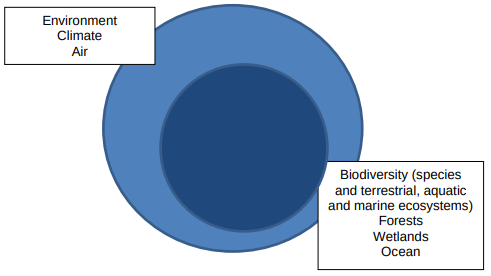
A 2022 working paper on identifying subsidies harmful to biodiversity published by the Organisation for Economic Co-operation and Development (OECD) depicted biodiversity as a subset of the environment, with climate and air falling outside the scope of “biodiversity”.
However, the report also noted that climate change is one of the five key drivers of biodiversity loss, adding:
“As such, subsidies that lead to larger greenhouse gas emissions, for example, will also indirectly impact on biodiversity.”
Prof Jessica Dempsey, a political ecologist at the University of British Columbia, tells Carbon Brief that she would “absolutely” consider fossil-fuel subsidies to be biodiversity-harming – not only as a driver of climate change, but also because the extraction of fossil fuels can cause localised harms to biodiversity. She adds:
“I do think probably it is true that all harmful subsidies are not necessarily biodiversity-related. Some care in that is important, but subsidies to the sectors that are known drivers of biodiversity loss feel very obvious to me.”
Biodiversity-harming subsidies can be either direct or indirect.
Direct subsidies refer to government expenditures that go towards a project that harms nature, such as construction of a new gas-fired power plant. Indirect subsidies could include tax exemptions that encourage a certain behaviour, such as lower tax rates on fuels for agricultural machinery.
Subsidies in agriculture, fishery and energy sectors are most commonly deemed “harmful”, but damage can also be caused by support for forestry, infrastructure, transport, construction, water and other sectors.
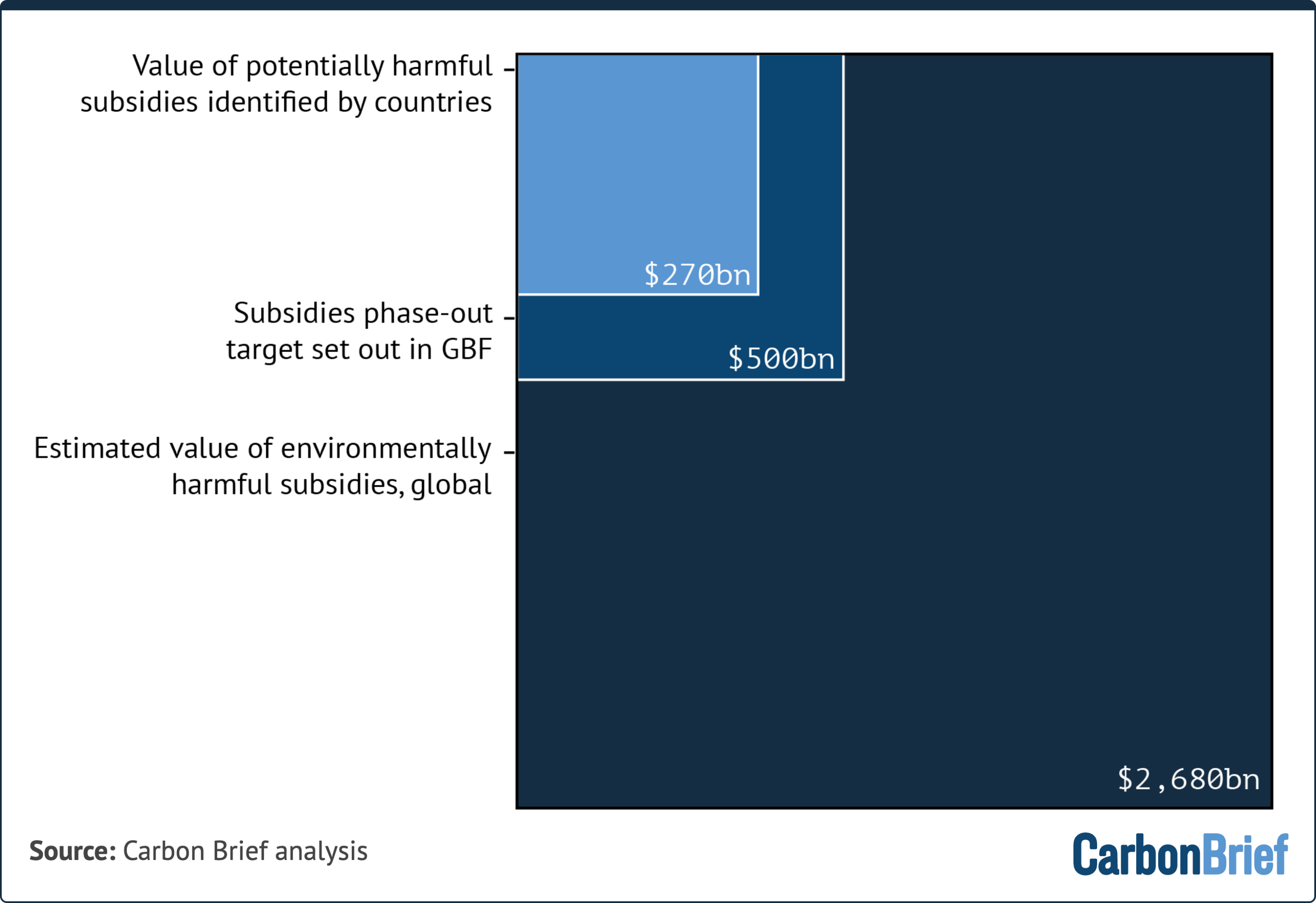
One recent estimate of the global total of biodiversity-harming subsidies put the figure at $1.7-3.2tn annually. An estimate of environmentally harmful subsidies put the figure at $2.6tn.
Elton tells Carbon Brief:
“It’s useful to contextualise the $500bn ambition of the GBF against those global estimates of how big [the total] actually could be, because that underscores the fact that so far, you’ve only got a subset of nations reporting about $250bn by your analysis, which is only half of the [phase-out target].
“It’s a significant lack of accountability.”
The chart below compares the $2.6tn estimated value of harmful subsidies to the $500bn phase-out target set in the GBF and the value of the subsidies identified so far in national reports.
Sectoral breakdown
Many subsidies can have both negative and positive impacts on biodiversity, according to the 2022 OECD working paper.
A subsidy on constructing dams for new hydropower can harm local biodiversity by disrupting water flows and flooding certain areas, for example. But it also reduces fossil-fuel dependence, lowering emissions and leading to a decrease in global warming.
Ronald Steenblik, a subsidies expert and co-author of the report estimating $2.6tn of harmful subsidies, tells Carbon Brief:
“What’s harmful is somewhat in the eye of the beholder.”
Most experts agree that a few sectors receive the bulk of the world’s biodiversity-harming subsidies: fossil fuels, agriculture and infrastructure, with much smaller contributions from other sectors, such as forestry, mining and fisheries.
Of the subsidies reported to the CBD, almost half were for the fossil-fuel sector, and around one-quarter for agriculture and fishing.
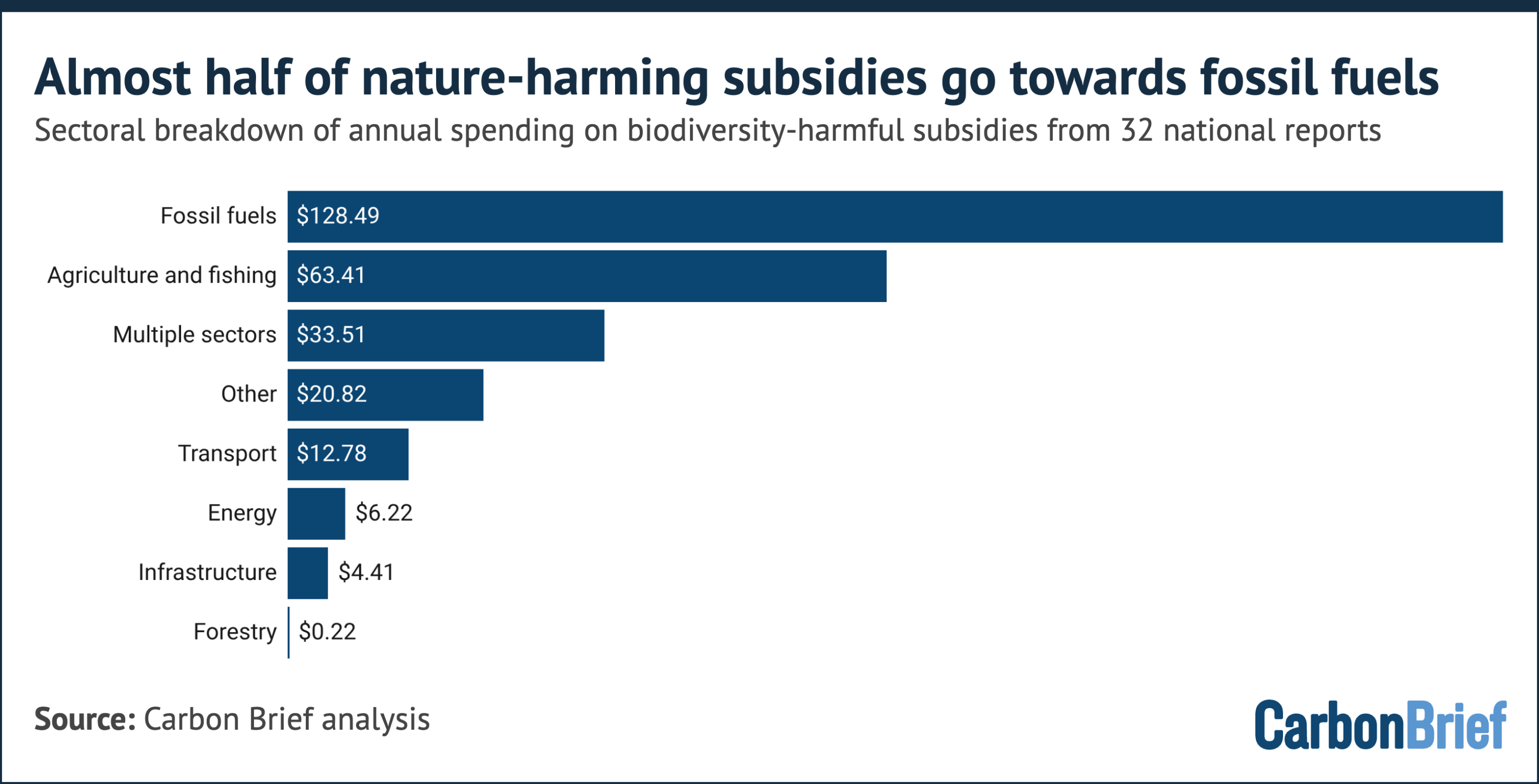
Dempsey says it is “surprising” that mining “didn’t show up” in these figures. (Of the 32 countries that provided subsidy data, only one mentioned mining as an industry that received harmful subsidies.)
Limitations
One limitation of Carbon Brief’s analysis is the lack of standardisation of subsidy data.
The methodology underlying the national reports lists several definitions of environmentally harmful subsidies, adding:
“[T]here is no standardised, globally agreed methodology for assessing the value of subsidies…nor is there a single global dataset providing this information.”
It adds that it is “important” for countries to identify harmful subsidies “within their national context”. Steenblik says:
“When you get down into the details, you can have lots of arguments of where you draw the line. And, so, the big question on this spreadsheet is where countries drew that line.”
For example, China’s national report says the country has already identified all biodiversity-harming subsidies and reformed them entirely.
In Australia, a 2026 study – led by Elton from Australian National University – identified biodiversity-harmful subsidies worth $26.3bn over 2022-23, a number that amounts to just over 1% of the country’s GDP.
However, in its national report, Australia identified $155m worth of subsidies, largely in the agricultural sector. (The national report says that the identified agricultural subsidies are those that are “potentially most harmful to the environment”.)
Elton tells Carbon Brief that this discrepancy underscores the necessity of an independent assessment of harmful subsidies, “rather than this just being seen as a tick-the-box reporting exercise by officials in the environment department”.
When it comes to actually phasing out harmful subsidies, Dempsey says, focusing on the quality of the subsidy – and who benefits from it – is just as important as focusing on the numbers. She adds:
“If we don’t take this lens of understanding the beneficiaries and we only focus on the [numbers], we really risk having policy changes that then lead to increased affordability problems for everyday working people, and backlash.”
Methodology
Carbon Brief analysed national reports submitted to the CBD by 134 parties – 133 countries and the EU – to assess which ones had identified all of their biodiversity-harmful subsidies and therefore met the 2025 deadline.
The reports were submitted in 2026, with the analysis including those submitted by 1 July 2026.
The figures for each country can be found in this spreadsheet. More than three-quarters of reports did not list any figures.
To get the full tally for the amount listed, Carbon Brief used the figures for 2025 (or the nearest available year) and converted the local currency into US dollars, based on conversion rates in the given year using the currency exchange rates calculator from the US Treasury.
These figures were then adjusted for inflation to the year 2025. Numbers were rounded to the nearest $1,000.
In total, this amounted to $269,856,769,000 in subsidies across 32 countries.
Many countries listed the sector that each subsidy is going towards. Carbon Brief standardised these inputs using the following categories:
- Agriculture and fishing
- Energy
- Forestry
- Fossil fuels
- Infrastructure
- Transport
- Other
- Multiple sectors
“Multiple sectors” was assigned when a country provided only a partial sectoral breakdown of their subsidies or none at all.
“Other” was selected to encompass sectors that were named more infrequently, including water, mining, tourism and construction.
The designations employed and the presentation of the material on the map in this article do not imply the expression of any opinion whatsoever on the part of Carbon Brief concerning the legal status of any country, territory, city or area or of its authorities, or concerning the delimitation of its frontiers or boundaries.